Thai curry paste is a concentrated blend of fresh herbs, dried spices, and aromatics that forms the flavor foundation of authentic Thai cooking. One jar can produce dozens of meals, from classic curries to quick weeknight stir-fries. Knowing how to use Thai curry paste correctly, including how much to add, how to cook it properly, and how to balance the final dish, is what separates a flat, one-note result from something that tastes like it came from a real Thai restaurant. This guide gives you every technique you need to get there.
How much Thai curry paste to use
Getting the amount right is the first step to a great dish. The standard starting point is 1 tablespoon of curry paste per 13.5 oz (400ml) can of coconut milk. That ratio produces a mild, approachable curry that works well for most households.
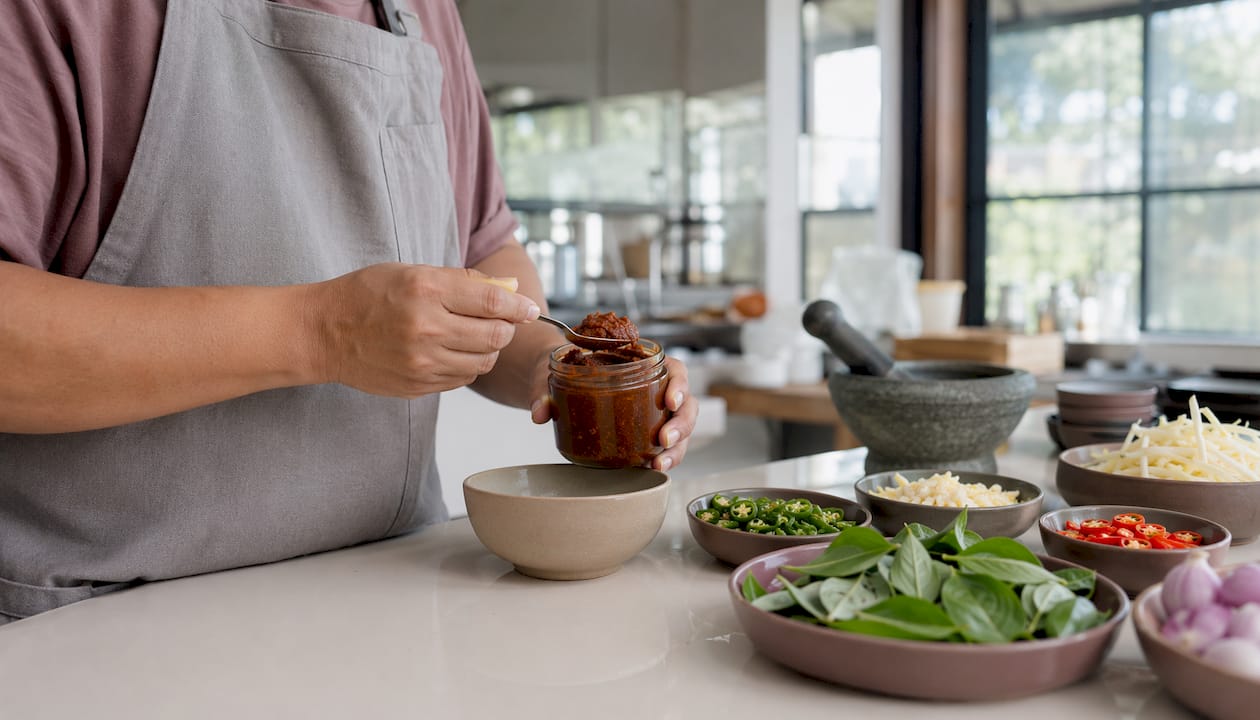
For family meals serving 3–4 people, the total amount of paste scales up based on the curry type and your heat preference. Green curry typically calls for 2–3 tablespoons, red curry for 3–4 tablespoons, yellow curry for 3–5 tablespoons, and Panang curry for 2–3 tablespoons. These ranges exist because each paste uses different chilies with different heat profiles.
The table below gives you a quick reference for each curry type.
| Curry type | Paste amount (3–4 servings) | Heat level |
|---|---|---|
| Green curry | 2–3 tablespoons | Sharp, immediate |
| Red curry | 3–4 tablespoons | Deep, building |
| Yellow curry | 3–5 tablespoons | Mild, warm |
| Panang curry | 2–3 tablespoons | Rich, moderate |
Always start at the lower end of the range. Heat is difficult to remove once it is cooked into a dish. You can always stir in more paste, but you cannot take it back out.
Pro Tip: If you are cooking for guests who are sensitive to spice, start with 1 tablespoon per can and offer a small dish of extra paste on the side for those who want more heat.
Why blooming your curry paste changes everything
Blooming is the single most important technique when cooking with curry paste. It means sautéing the paste in fat before adding any liquid. This step releases the essential oils locked inside the herbs and spices, which transforms raw paste into a deeply aromatic, cohesive base.
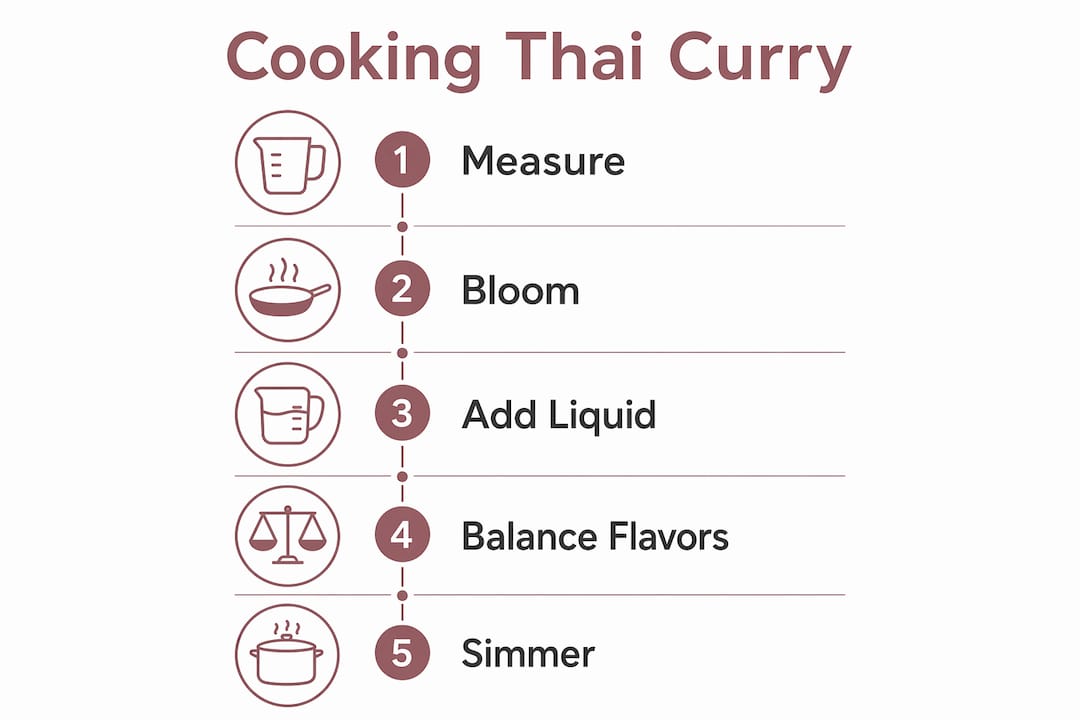
Skipping this step is the most common mistake home cooks make. Adding raw paste directly to liquid produces a harsh, unbalanced flavor that no amount of seasoning can fully fix. The paste needs heat and fat to open up.
Here is how to bloom paste correctly:
- In oil: Heat a neutral oil like vegetable or coconut oil over medium heat. Add the paste and stir constantly for 60–90 seconds. You will see the color deepen and smell the aroma intensify.
- In coconut cream: Spoon the thick cream from the top of an unshaken can of coconut milk into your pan. Cook the paste in the cream over medium heat for 3–5 minutes, stirring frequently.
- Signs it is ready: The oil will begin to separate from the paste and pool around the edges. The raw smell will shift to a toasted, fragrant aroma.
Blooming in coconut cream produces a richer result than oil alone because the fat in the cream carries the aromatic compounds more effectively. This is the insider technique that makes restaurant-style Thai curry taste so much fuller than a home version where the paste was just stirred into liquid.
Pro Tip: Buy full-fat coconut milk and do not shake the can before opening. The thick cream that sits on top is your blooming fat. Scoop it out first, bloom your paste in it, then pour in the remaining liquid coconut milk.
What else can you do with Thai curry paste?
Thai curry paste is far more useful than most home cooks realize. It works in stir-fries, marinades, soups, dipping sauces, and noodle dishes, not just traditional curries. A single jar can cover a full week of varied meals.
Here are the most practical ways to use it beyond a standard curry:
- Stir-fry: Add 1–2 tablespoons of paste directly to a hot wok with oil. Toss in your protein and vegetables and cook over high heat. No coconut milk needed. The paste coats everything and delivers bold flavor fast.
- Marinade: Mix 1 tablespoon of paste with 2 tablespoons of coconut milk, 1 teaspoon of fish sauce, and 1 teaspoon of palm sugar. Use it on chicken, shrimp, or tofu before grilling or roasting.
- Soup base: Stir 1–2 tablespoons of paste into a simmering broth. It adds depth and complexity without requiring a full curry build. This works especially well in a simple chicken or vegetable soup.
- Dipping sauce: Thin the paste with coconut milk and a squeeze of lime juice. Add a pinch of sugar and a few drops of fish sauce. The result is a quick sauce for spring rolls, grilled meats, or raw vegetables.
- Fried rice or noodles: Add a small amount of paste, about 1 teaspoon per serving, to the pan before adding your rice or noodles. It gives the dish a warm, aromatic backbone without making it taste like curry.
The key in all of these applications is to cook the paste in fat first, even briefly. That blooming step applies whether you are making a full curry or a quick weeknight stir-fry.
How to balance flavors after adding curry paste
Getting the seasoning right at the end of cooking is what separates a good dish from a great one. Curry paste brands vary widely in saltiness and concentration, so you cannot rely on the paste alone to season the dish. You always need to taste and adjust.
The three main tools for balancing a Thai curry are palm sugar, lime juice, and fish sauce.
- Add palm sugar to soften sharp edges. Start with approximately 1 teaspoon of palm sugar per tablespoon of paste used. Palm sugar rounds out the heat and bitterness without making the dish taste sweet. Brown sugar works as a substitute if palm sugar is not available.
- Squeeze in lime juice to brighten the dish. This is especially important for green curry, which can taste flat without acidity. Add lime juice at the very end of cooking, not during simmering, so the brightness stays fresh.
- Use fish sauce to adjust saltiness and umami. Add it one teaspoon at a time and taste between additions. Fish sauce is potent, and a little goes a long way.
- Taste at the very end, not during cooking. Flavors concentrate as liquid reduces, so what tastes balanced mid-cook may taste too salty or too sharp by the time you serve it.
- Fix a weak curry with a paste emulsion. If your finished curry tastes thin or lacks depth, sauté extra paste separately in a small pan with a little oil, then stir it back into the curry. This technique adds flavor without creating clumps of uncooked paste.
Pro Tip: Keep a small bowl of palm sugar, a cut lime, and fish sauce next to the stove while you cook. Tasting and adjusting in small increments at the end is the fastest way to get the balance right.
Key Takeaways
Cooking with Thai curry paste well comes down to three non-negotiable steps: bloom the paste in fat, use the right amount for your curry type, and balance the final dish with palm sugar, lime juice, and fish sauce.
| Point | Details |
|---|---|
| Start with the right ratio | Use 1 tablespoon of paste per 13.5 oz can of coconut milk as your baseline. |
| Always bloom the paste | Sauté paste in oil or coconut cream for 60–90 seconds before adding liquid. |
| Adjust by curry type | Green and Panang use 2–3 tbsp; red and yellow use up to 4–5 tbsp for 3–4 servings. |
| Balance at the end | Add palm sugar, lime juice, and fish sauce after cooking to round out the flavor. |
| Use paste beyond curries | Stir-fries, marinades, soups, and dipping sauces all benefit from a small amount of paste. |
What I have learned from years of cooking with curry paste
The advice I give most often to newer cooks is this: do not skip the bloom, even when you are in a hurry. I understand the temptation. You are tired, the pan is hot, and it seems like one extra step that probably does not matter. It does matter. Every time I have rushed past it, the dish tasted noticeably flatter. Every time I took 90 seconds to properly sauté the paste, the result was richer and more satisfying.
The second thing I have learned is to treat store-bought paste as a starting point, not a finished product. Traditional hand-pounded paste made with a mortar and pestle releases more oils and delivers more complexity than anything from a jar. But quality store-bought pastes are genuinely good, and for a busy home cook, they are the right call. The key is what you do with them after they come out of the jar.
I also used to add too much paste early in my cooking. I thought more paste meant more flavor. What it actually meant was more heat with less control. Starting low and adjusting up taught me more about how each paste behaves than any recipe ever did. You learn the paste by working with it gradually, not by dumping in the whole jar.
— William
Ready to cook more meals you are proud of?
If cooking with Thai curry paste has you excited about what else you can make at home, Adultingwithfood was built for exactly this moment.

Adultingwithfood is a digital cooking membership that gives you weekly recipe drops, grocery checklists, and real chef support so you can build genuine kitchen confidence. Members get the Adulting With Food Starter Pack with everything they need to stop relying on takeout and start making meals they are actually proud of. Whether you are brand new to cooking or just looking to level up your skills, the resources are there to help you grow at your own pace.
FAQ
How much curry paste should I use per can of coconut milk?
The standard ratio is 1 tablespoon of curry paste per 13.5 oz can of coconut milk. Scale up to 2–5 tablespoons for 3–4 servings depending on the curry type and your heat preference.
What does blooming curry paste mean?
Blooming means sautéing the paste in oil or coconut cream before adding liquid. This step takes 60–90 seconds in oil or 3–5 minutes in coconut cream and releases the essential oils that give the dish its full, authentic flavor.
Can I use Thai curry paste without coconut milk?
Yes. Curry paste works well in stir-fries, marinades, and soups without coconut milk. Add it directly to a hot pan with oil and cook briefly before adding your protein or vegetables.
Why does my curry taste flat even after adding paste?
Flat flavor usually means the paste was not bloomed properly or the dish needs seasoning adjustment. Try the recovery method: sauté extra paste separately in oil and stir it back into the curry, then add palm sugar, lime juice, and fish sauce to taste.
Is store-bought Thai curry paste good enough?
Quality store-bought paste is a practical and effective option for home cooks. The flavor is less complex than hand-pounded paste, but proper blooming and seasoning adjustments close most of that gap.