
Your first apartment kitchen essentials boil down to about ten items: a 10-inch nonstick skillet, a 3-quart saucepan with a lid, an 8-inch chef's knife, a cutting board, a half sheet pan, a few basic utensils, measuring cups and spoons, nesting mixing bowls, and one compact appliance like an electric kettle or toaster oven. Buy those first, cook with them for a month, then add quality-of-life upgrades once you know your actual habits. Skip the 12-piece cookware sets. You'll use maybe four pieces from any of them.
TL;DR:
- A 10-inch nonstick skillet handles about 70% of weeknight cooking tasks, making it the highest utility item to prioritize over larger or multiple pans.
- Buying a small set of essential tools, including a single quality chef's knife and a few versatile utensils, is more cost-effective than investing in bulky cookware sets.
- A budget starter kit around $100 to $150 should include basic cookware, a knife, cutting board, sheet pan, and measuring tools, with optional upgrades spaced over time.
- Small appliances like an electric kettle, toaster oven, or basic drip coffee maker justify their counter space, while more specialized gadgets can be added later as needed.
- Emphasizing proper storage, including stacking, hanging, and no-drill organization hacks, maximizes small kitchen space without costly renovations.
Table of Contents
- Core Cookware and Prep Tools to Buy First
- Knives, Cutting Boards, and Essential Prep Tools
- Small Appliances That Earn Their Counter Space
- Pantry Staples and Dining Basics for Easy Meals
- Small-Space Organization and Storage Hacks
- Budget Tiers and a Shopping Strategy That Won't Break You
- Choose Your First-Apartment Fighters: A Priority Shopping List
- Cleaning and Maintenance Essentials You Can't Skip
- Why Starting Small Actually Builds Better Cooking Skills
- How AdultingintheKitchen Helps You Skip the Trial and Error
- Sources
Core Cookware and Prep Tools to Buy First
The biggest mistake new renters make is buying a cookware set instead of building a kitchen piece by piece. A boxed set gives you eight pans and you'll reach for two of them. Build around a small number of tools that each pull double or triple duty, and you'll spend less while cooking more.
A 10 to 12-inch nonstick skillet is the single highest-utility pan you can own, and 10 inches is the sweet spot for most first apartments. It's big enough to sear a chicken breast, scramble eggs for two, or sauté a full bag of vegetables without crowding the pan, and small enough to heat evenly on the kind of narrow electric burner you'll find in most rental units. Go smaller (an 8-inch pan) and you'll be cooking in shifts. Go bigger (a 12-inch pan) and you'll fight it on tight stovetops and struggle to store it in a small cabinet, a sizing tradeoff All-Clad's guide to pan sizing lays out clearly.
Round out the core set with a 3-quart saucepan with a lid for rice, pasta, soup, and sauces, plus a half sheet pan for roasting vegetables, baking chicken thighs, or reheating leftovers in the oven. That trio, alongside the knife and cutting board, covers the overwhelming majority of weeknight cooking. It's essentially the same short list Bon Appétit's first-apartment kitchen guide recommends to new cooks furnishing a kitchen from zero: a nonstick skillet, a lidded saucepan, a chef's knife, and a sheet pan, nothing more.
Here's what actually earns cabinet space in month one:
- 10 to 12-inch nonstick skillet (aluminum or ceramic coated, budget brands are fine here)
- 3-quart saucepan with a fitted lid
- Half sheet pan (aluminum, roughly $10 to $15)
- Nesting mixing bowl set (three sizes that stack inside each other)
- Instant-read thermometer
Pro Tip: Buy the cheapest version of your skillet and saucepan for year one. Nonstick coatings wear out with heavy use regardless of price, so there's no reason to spend $80 on a pan you might replace in two years anyway. Save your money for the knife instead.
Don't skip the instant-read thermometer. It's a five-dollar tool that solves the single biggest anxiety new cooks have: not knowing if chicken is actually done. Guessing leads to either dry, overcooked meat or undercooked meat that isn't safe to eat, and Bon Appétit's editors specifically call it out as a tool that removes the guesswork for newer cooks handling proteins for the first time. Check the internal temperature instead of cutting into the meat and hoping.
One statistic worth remembering: a 10-inch skillet reportedly handles roughly 70% of weeknight cooking tasks on its own, from eggs to stir-fry to pan sauces. That's not a coincidence. It's why so many "starter kit" guides converge on the same size instead of pushing bigger cookware.
Store your nesting bowls inside each other, stack your saucepan lid separately so it doesn't scratch the coating, and hang your sheet pan vertically in a cabinet divider if you have one. Small kitchens live or die on how well things stack.
Knives, Cutting Boards, and Essential Prep Tools
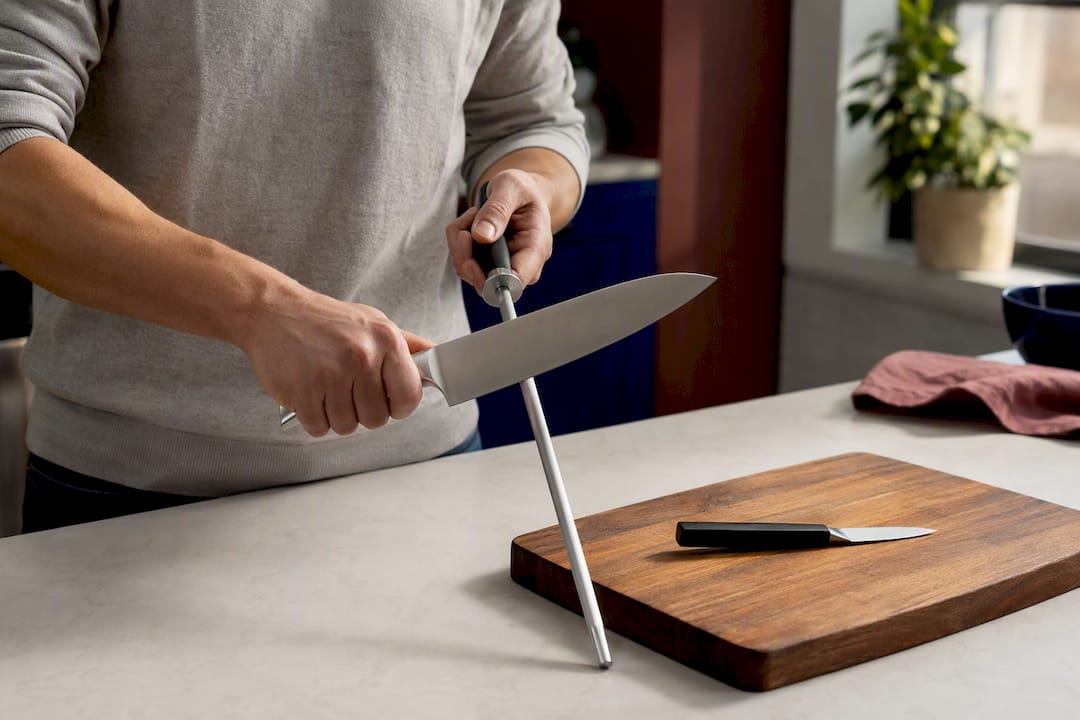
You do not need a knife block. You need one good knife and the discipline to keep it sharp.
An 8-inch chef's knife handles roughly 90% of cutting tasks, from dicing onions to breaking down a chicken to slicing bread. Add a small paring knife for detail work like trimming strawberries or deveining shrimp, and you've covered nearly everything without spending $200 on a twelve-piece set that mostly gathers dust in a drawer. That's the exact pairing Serious Eats recommends for anyone building a kitchen from scratch: one quality chef's knife, one cheap paring knife, done.
Here's the safety piece nobody tells you until they've bled on a cutting board: a dull knife is more dangerous than a sharp one. A sharp blade glides through what you're cutting with light pressure and predictable control. A dull blade needs force, and force is exactly what causes it to slip and land on your finger instead of the onion. If your knife is struggling to cut a tomato without squashing it, that's your sign it needs attention.
Set yourself up right with these:
- 8-inch chef's knife — your workhorse for 90% of tasks
- Paring knife — detail work, small fruit, garnish
- Cutting board — one large plastic board (dishwasher safe) plus a small second board for raw meat
- Tongs — for flipping, tossing, and serving without touching food
- Wooden spoon and silicone spatula — stirring and scraping without scratching nonstick coating
- Vegetable peeler and can opener — small tools, constant use
- Measuring cups and spoons — one nesting set of each
Choose a plastic cutting board for your primary board. It's dishwasher safe, doesn't need oiling, and won't warp if you forget it in the sink overnight, which you will. Wood boards look nicer and are gentler on knife edges, but they need hand washing and occasional oiling to avoid cracking, upkeep most first apartments don't have room for early on.
Pro Tip: Hone your knife with a honing rod every few uses to realign the edge, and get it professionally sharpened once or twice a year. Honing isn't sharpening, it just keeps an already sharp edge working correctly between real sharpenings. For more on building out this toolkit, AdultingintheKitchen's guide to basic cooking tools for beginners walks through how each piece gets used in a real weeknight routine.
Small Appliances That Earn Their Counter Space
Counter space in a first apartment is precious, usually about two feet of it, so every appliance you buy needs to justify sitting there permanently.
Three appliances consistently earn their spot. An electric kettle boils water in under three minutes for pasta, tea, coffee, or instant ramen, and it's faster and safer than waiting on a stovetop pot. A toaster oven or air fryer combo reheats leftovers, roasts vegetables, and bakes small portions without heating your entire apartment the way a full oven does in summer. And if you drink coffee daily, a basic drip coffee maker saves real money over months of coffee shop runs, but skip it if you're not a daily coffee drinker. It's a five-dollar-a-day habit disguised as a one-time purchase.
Everything else waits. Here's what to hold off on:
- Waffle makers and bread machines (single-use, rarely used more than a few times before storage)
- Stand mixers (expensive, heavy, only worth it once you're baking regularly)
- Rice cookers (nice, but your 3-quart saucepan already does this job)
- Panini presses and specialty grills (your skillet handles sandwiches fine)
The rule is simple: delay any appliance that does one job your existing cookware already does. You'll know within a few months whether you actually bake enough to justify a stand mixer or grill enough to justify a panini press. Buying before you know wastes money and counter space you don't have to spare.
One safety note that trips up a lot of first-time renters: check your lease and building rules before plugging in space heaters, hot plates, or high-wattage appliances. Some buildings restrict certain appliances for fire-safety reasons, and older buildings sometimes have circuits that trip if you run a toaster oven and a microwave at once. Ask your landlord or building manager before you assume anything is allowed.
Pantry Staples and Dining Basics for Easy Meals
An empty pantry makes even simple recipes feel impossible, since you can't season anything or improvise when you're short an ingredient. Stock these basics first, and most weeknight recipes become achievable without an extra grocery run.
Your pantry foundation should include:
- Kosher salt and black pepper (the two seasonings you'll reach for daily)
- Olive oil and a neutral cooking oil (vegetable or canola)
- Dried pasta and rice (cheap, shelf stable, endlessly versatile)
- Canned beans and canned tomatoes (instant base for soups, chilis, sauces)
- Tinned fish like tuna or salmon (fast protein with zero prep)
- A few basic spices: garlic powder, paprika, dried oregano or Italian seasoning
- White vinegar or a basic cooking vinegar for acidity in sauces and dressings
For dining, you don't need a full set for eight. Buy two to four place settings (plate, bowl, glass, mug) so you can eat comfortably and host a friend without borrowing dishes. Add a set of stackable storage containers for leftovers, since good storage is half the battle against food waste in a small fridge.
Buy store-brand pantry staples wherever possible. Salt, pasta, canned beans, and oil rarely differ in quality between store brand and name brand, and the savings add up fast over a month of groceries. Save your name-brand budget for things where quality is more noticeable, like olive oil or coffee.
Small-Space Organization and Storage Hacks
Small apartment kitchens don't need more cabinets. They need better use of the ones they have, and most of the best fixes require zero drilling, which matters if your lease bans wall damage.
A magnetic knife strip mounted with adhesive strips keeps your chef's knife off the counter and out of a drawer where it dulls against other utensils. A fridge-side magnetic spice rack uses vertical space that otherwise goes to waste. Over-the-door organizers on a pantry or cabinet door hold spices, foil, or cutting boards without eating shelf space. General small-space wisdom favors this kind of vertical thinking: if it can hang, hang it, and save flat surfaces for things that genuinely need them.
Nesting and stacking do the rest of the work. Buy mixing bowls, saucepans, and storage containers that nest inside each other rather than a matched set that only stacks one way. This single habit alone can double your usable cabinet space, an approach echoed across most first-apartment kitchen checklists built for small units.
A few more space savers worth the ten dollars:
- Over-the-sink drying rack (uses dead space above the sink instead of counter real estate)
- Slim rolling cart for extra pantry storage if cabinets run short
- Plate stackers inside cabinets to prevent tall, tippy stacks
Pro Tip: Before you buy any storage product, empty one cabinet completely and see how it's actually being wasted. Most small kitchens lose space to awkward gaps above stacked items, not a shortage of storage itself. For a deeper look at renter-friendly setups, Value Blinds Direct's guide to organizing small apartments covers no-drill solutions that extend beyond the kitchen.
Budget Tiers and a Shopping Strategy That Won't Break You
Buying everything on day one is how people end up with $600 in credit card debt and a drawer full of gadgets they never use. Phased buying works better, and it's the approach most cost breakdowns for first-apartment kitchens point to for a reason: it matches spending to actual need instead of guessing upfront.
| Tier | Budget Range | What It Covers |
|---|---|---|
| Survival / Essentials | $100 to $150 | Skillet, saucepan, knife, cutting board, sheet pan, basic utensils, measuring tools |
| Quality of Life | $150 to $250 | Better cookware, small appliance (kettle or toaster oven), full dish set, storage containers |
| Upgrades | $250 and up | Cast iron skillet, stand mixer, specialty tools, upgraded knife set |
A tight-budget starter pack sticks to survival tier only: skillet, saucepan, knife, board, sheet pan, and a handful of utensils, often achievable for roughly $100 to $150 total. A modest budget stretches into quality-of-life items, adding a kettle or toaster oven and real dishware for two to four people.
Buy the skillet and knife new, since coating and blade quality matter and used versions are often already worn out. Buy sheet pans, mixing bowls, and dishware secondhand or from a discount store without hesitation. Nobody can tell the difference once it's in your cabinet.
Choose Your First-Apartment Fighters: A Priority Shopping List
If you're standing in a store with a short list and a tighter budget, shop in this order:
- 10-inch nonstick skillet — covers the most meals of any single item
- 8-inch chef's knife — everything starts with cutting something
- Cutting board — pairs directly with the knife, buy together
- 3-quart saucepan with lid — unlocks pasta, rice, and soup
- Half sheet pan — unlocks the oven for roasting and reheating
- Nesting mixing bowls — prep, mixing, and storage in one purchase
- Measuring cups and spoons — needed the moment you follow a real recipe
- Tongs and a spatula — basic handling tools for the skillet and pan
If your budget only stretches to five items, buy the skillet, knife, cutting board, saucepan, and a wooden spoon. That combination alone gets you through most weeknight dinners.
Cleaning and Maintenance Essentials You Can't Skip
Cookware only stays useful if you take care of it, and cleaning supplies are easy to forget until moving day arrives and you have nothing to wash a single dish.
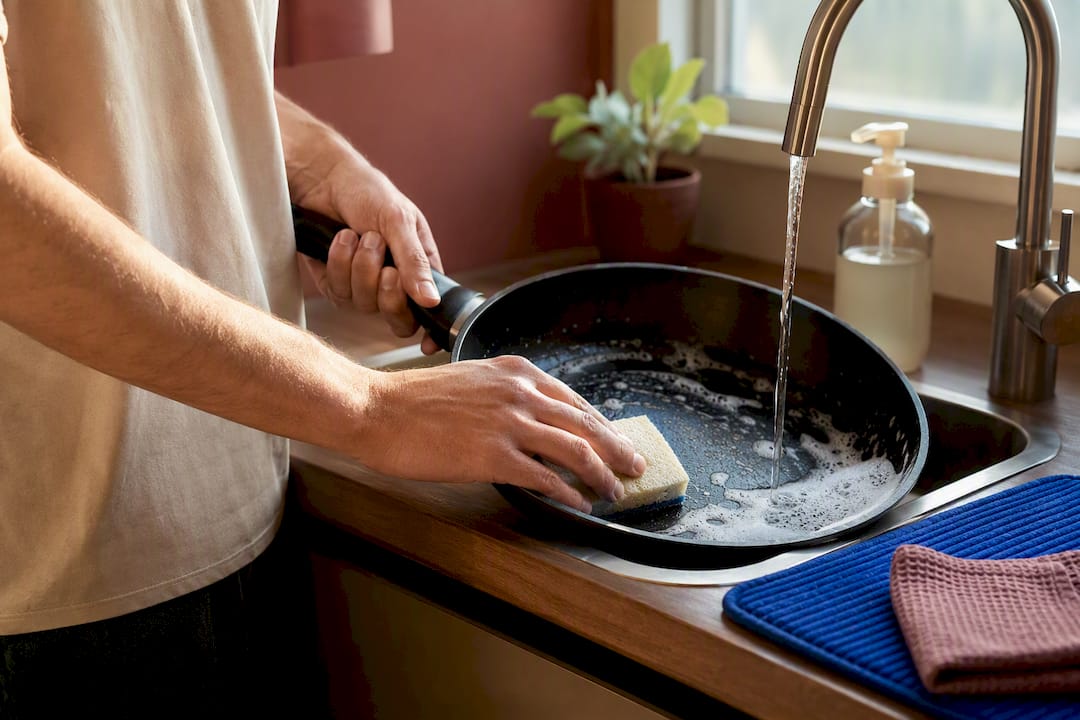
Stock a few non-scratch sponges for nonstick pans (steel wool will destroy the coating fast) plus a stiffer scrub brush for pots and pans that need more force. Pick up a bottle of dish soap that cuts grease well, and a dish rack or drying mat so wet dishes have somewhere to go besides your counter. A drying rack also protects your knife's edge, since air drying beats tossing it in a sink full of other dishes where the blade can chip or dull against ceramic.
Round it out with basics that feel obvious until you're out of them at 11pm: dish towels, a couple of microfiber cloths for counters, an all-purpose cleaning spray, and a steady supply of trash bags sized to your kitchen can. Buy trash bags in bulk once you know your can's size. Running out mid-week and using grocery bags as a substitute is a classic first-apartment moment nobody needs to repeat twice.
Wash your nonstick skillet by hand rather than in the dishwasher. Dishwasher detergent is harsher than dish soap and shortens the life of nonstick coatings noticeably faster than gentle hand washing does.
Why Starting Small Actually Builds Better Cooking Skills
Most people overbuy their first kitchen because they're anxious about not having the "right" tool for every possible recipe. That anxiety is backwards. A cook with five solid tools and a decent recipe learns faster than a cook with thirty tools and no plan, because constraint forces you to actually understand what each tool does. Add gear as your skills and habits reveal what you're missing, not before. Guided recipes and real support from someone who's cooked before matter more early on than another gadget in the drawer.
— Bill
How AdultingintheKitchen Helps You Skip the Trial and Error
Buying the right gear solves half the problem. Knowing what to actually cook with it solves the other half, and that's where most first-apartment kitchens stall out after the initial shopping trip. AdultingintheKitchen is built for exactly that gap: a membership that pairs your starter kit with the knowledge to use it well, instead of leaving you to figure it out through trial, error, and wasted groceries.
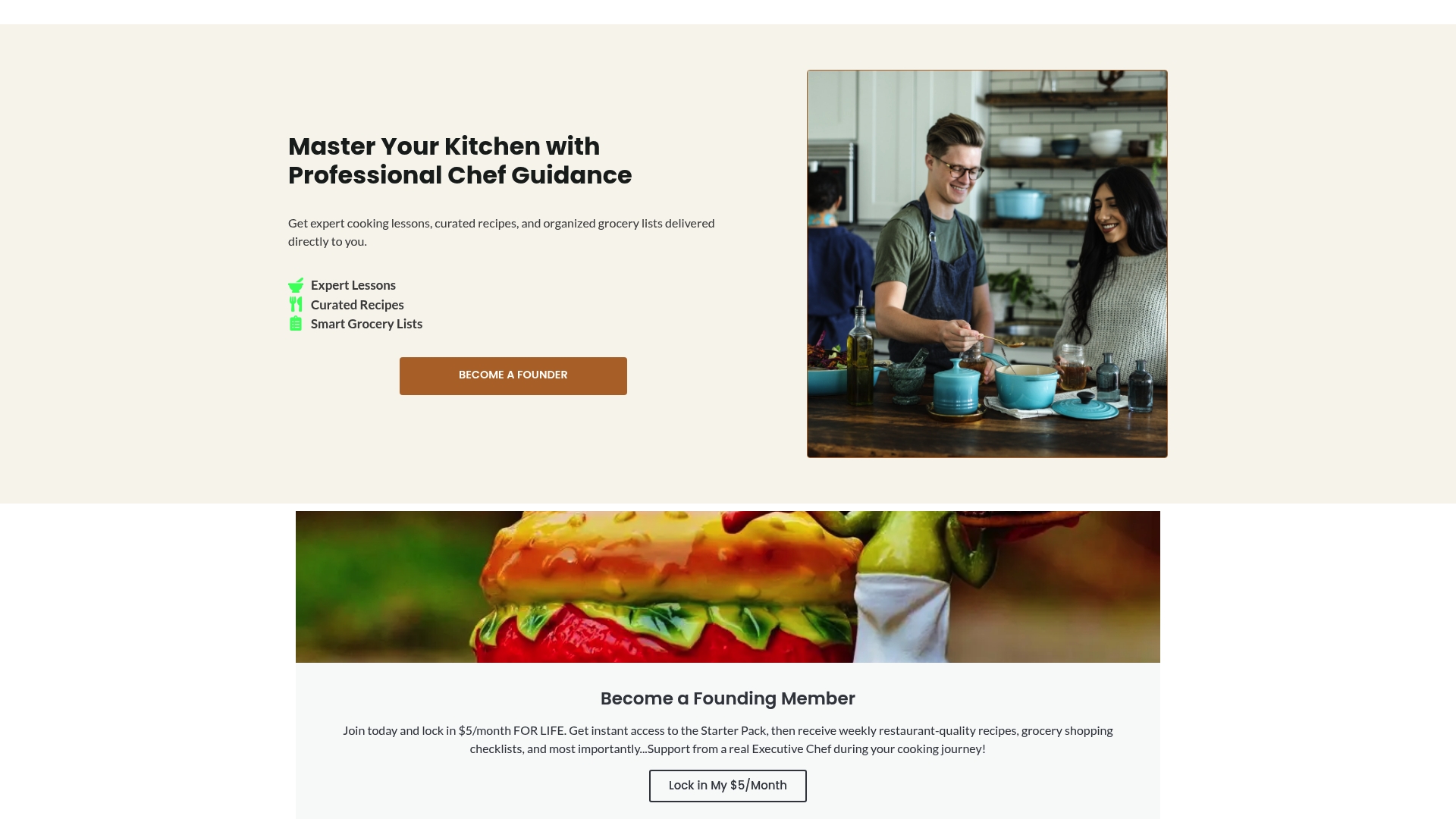
Members get the Adulting in the Kitchen Starter Pack, which maps directly onto the tiered shopping plan above, so you're not guessing what to buy next. On top of that, you get weekly recipe drops with 5 new recipes, grocery store checklists that take the guesswork out of shopping trips, and real chef support when a recipe isn't turning out the way you expected. Instead of buying gear based on hope, you're buying it based on what you're actually cooking that week, which is exactly the phased approach this whole guide has been pushing.
If your cookware drawer is set but your confidence isn't, that's the piece worth solving next. Check out the AdultingintheKitchen membership and see what a guided starter pack looks like when it's paired with real recipes and real support.
Sources
- So, You Just Got Your First Apartment—Here's What Your Kitchen Actually Needs | Bon Appétit
- First Apartment Kitchen Essentials 2026: What You Actually Need