
Hydrate tender herbs like a bouquet, control humidity for hardy herbs, and reach for the freezer or a dehydrator when you need weeks instead of days. Trim the stems on soft herbs and stand them in water; wrap woody herbs in a damp paper towel and seal them up. Basil breaks the rule entirely and prefers a spot on the counter. Handled right, most fresh herbs stay usable for one to three weeks, and freezing or drying stretches that to months.
TL;DR:
- Tender herbs like parsley and cilantro should be stored upright in water and kept in the fridge, with water changed every 2 to 3 days.
- Hardy herbs such as rosemary and thyme are best wrapped in a damp paper towel and stored in a sealed container in the fridge crisper drawer for two to three weeks.
- Basil must be kept at room temperature like a bouquet and not refrigerated, as cold injury causes rapid darkening and sliminess.
- Freezing herbs in oil cubes or flat freezer bags preserves flavor for up to 12 months, but textural quality diminishes for raw use.
- Dried herbs stored in airtight jars in a cool, dark place retain flavor for about three months, extending longer if refrigerated or frozen.
Table of Contents
- How Do You Store Fresh Herbs Based on Type?
- Should You Wash Herbs Before Storing Them?
- How Do You Store Tender Herbs in Water?
- Why Does Basil Need Different Storage Than Other Tender Herbs?
- How Do You Store Hardy Herbs Like Rosemary and Thyme?
- What Are the Best Ways to Freeze Herbs?
- How Do You Dry Herbs for Long-Term Storage?
- How Long Do Stored Herbs Actually Stay Fresh?
- How Do You Fix Slimy, Moldy, or Freezer-Burned Herbs?
- Why Do These Herb Storage Methods Actually Work?
- A Weekly Herb Routine That Actually Sticks
- Want Help Turning Habits Like This Into a Whole Cooking Routine?
- Sources
- FAQ
How Do You Store Fresh Herbs Based on Type?
Every herb falls into one of two camps, and knowing which one you're holding determines everything about how you store it. Get this classification wrong, and even a perfect technique won't save your basil or your rosemary.
Tender herbs have soft, hollow, or delicate stems and leaves that wilt fast once cut. Think parsley, cilantro, dill, mint, chives, and basil (which gets its own rules below). These herbs are mostly water by weight, so they lose moisture and go limp within a day if left exposed to fridge air.
Hardy herbs have woody or fibrous stems and tougher, waxier leaves built to hold moisture. Rosemary, thyme, oregano, sage, and marjoram belong here. Their thicker cell walls and lower water content mean they can tolerate drier storage conditions without collapsing.
- Tender herbs: soft stems, high water content, wilt within hours of dehydration. Quick rule: keep them wet.
- Hardy herbs: woody stems, waxy leaves, resist moisture loss. Quick rule: keep them just damp, not wet.
If you're not sure which category an herb falls into, bend the stem. If it snaps or feels fibrous, treat it as hardy. If it folds without resistance, treat it as tender.
Should You Wash Herbs Before Storing Them?
Yes, washing helps, as long as you dry the herbs completely afterward. Skipping this step leaves field dirt, pesticide residue, or grocery store moisture on the leaves, and residual water sitting on herbs is often the real culprit behind early sliminess and mold, not the washing itself.
- Rinse gently under cool water, swishing leaves rather than scrubbing them.
- Spin dry in a salad spinner, which removes far more surface water than shaking or air drying alone.
- Blot any remaining damp spots with a clean kitchen towel or paper towels.
- Trim the stem ends at an angle and pull off any yellowed or slimy leaves before storing.
Tests on washing versus skipping it found that herbs washed and thoroughly dried sometimes outlasted unwashed bunches in storage comparisons, because removing surface debris slows the bacterial growth that triggers decay.
Pro Tip: Be gentle with the spin cycle on delicate herbs like dill or cilantro. Rough handling bruises the leaves, and bruised cells release moisture that speeds up spoilage even in a perfectly set up storage jar.
How Do You Store Tender Herbs in Water?
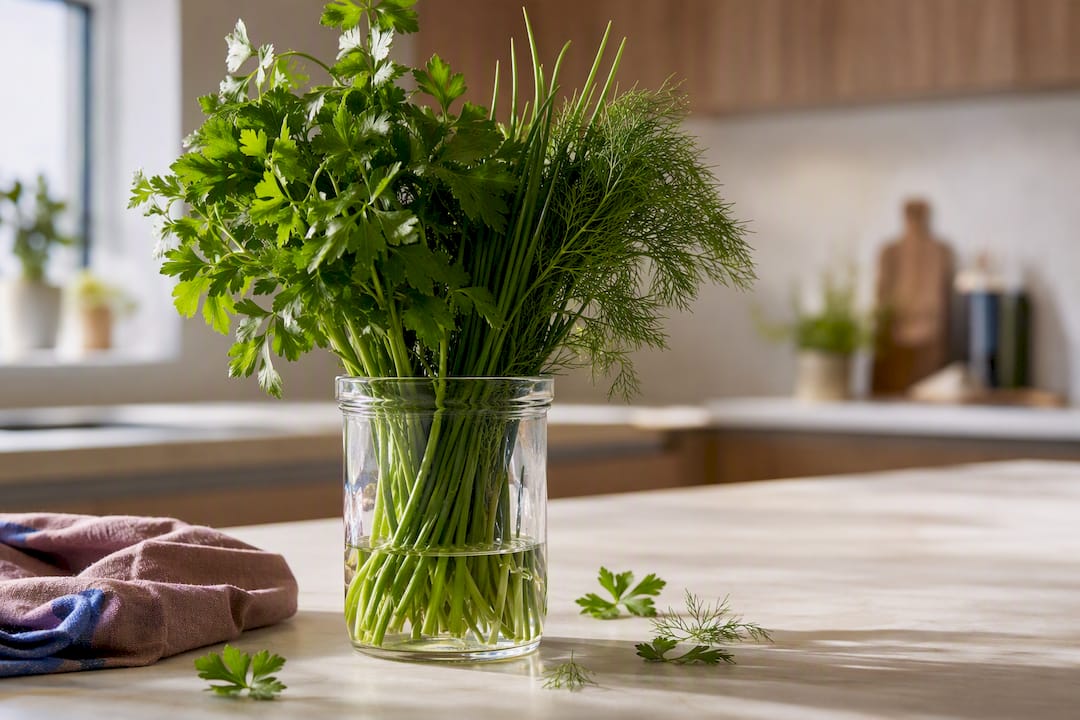
Treat parsley, cilantro, dill, mint, and chives exactly like cut flowers. Trim about half an inch off the stems, then stand them upright in a jar with roughly one inch of water covering the cut ends. Cover the leaves loosely with a produce bag to trap humidity around the foliage without suffocating it, then place the jar in the refrigerator.
Set it toward the front or in the door if your fridge runs cold in the back. Herbs stored this way can stay fresh for about two weeks, and side-by-side testing has found the jar-of-water method consistently outperforms bags or plastic wrap for tender varieties.
- Change the water every 2 to 3 days, or sooner if it looks cloudy.
- Re-trim the stems slightly whenever you change the water to keep the cut ends fresh and absorbing.
- Keep the bag loose enough for airflow. A tightly sealed bag traps too much condensation and invites mold.
The most common mistake is letting leaves droop into the water instead of staying above it. Submerged leaves break down fast and cloud the water within a day. The second most common mistake is placing the jar against the back wall of the fridge, where temperatures often dip below what tender herbs can handle.
Pro Tip: If a stem or two starts to go slimy in the jar, pull it immediately. One rotting stem in the bunch speeds up decay for everything nearby.
Why Does Basil Need Different Storage Than Other Tender Herbs?
Basil looks like a tender herb, but it behaves more like a tropical houseplant. It's genuinely cold-sensitive, and refrigeration causes chilling injury that turns the leaves dark and slimy within a day or two, even though the same fridge temperature keeps parsley perfectly happy.
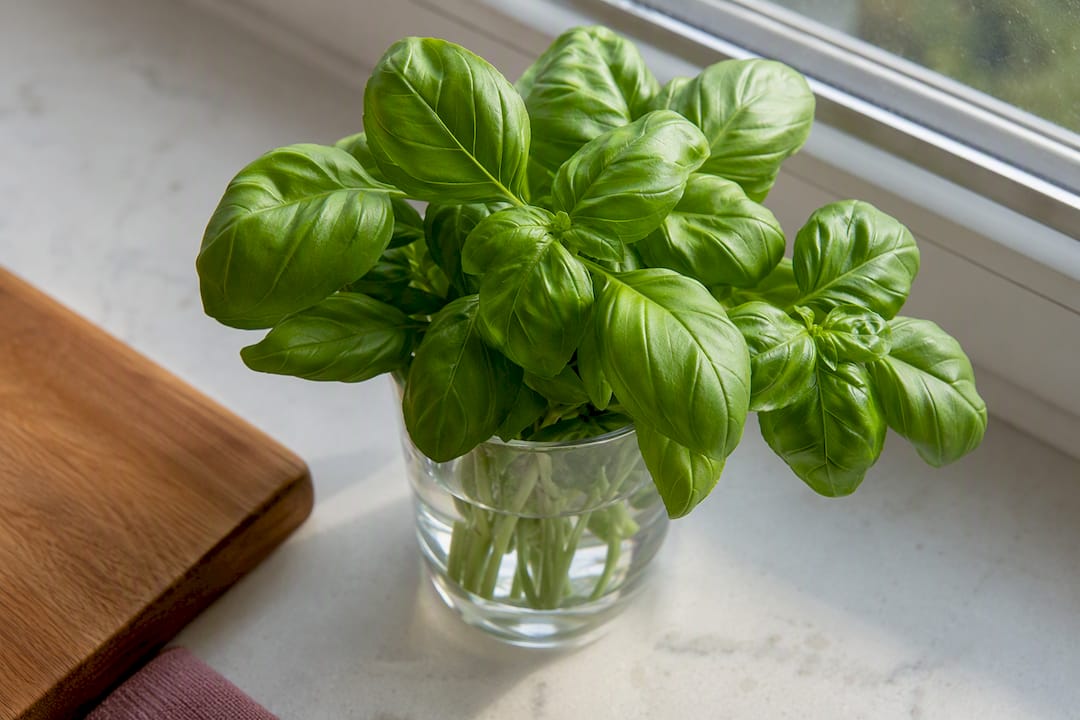
Store basil at room temperature, in a jar with about an inch of water, leaves left uncovered and out of direct sun. Treat it exactly like a bouquet of flowers on the counter, and it can hold up for close to a week. If your kitchen runs hot, a very brief chill of a few hours is fine, but leaving it in the fridge overnight is what causes the blackening. Basil that has already darkened at the edges is still safe to use in cooked sauces or pesto. Just trim away any slimy sections first.
How Do You Store Hardy Herbs Like Rosemary and Thyme?
Wrap rosemary, thyme, oregano, sage, or marjoram in a slightly damp paper towel and seal them inside a resealable bag or airtight container.
- Dampen a paper towel so it's moist but not dripping. Wring out any excess water.
- Lay the herbs in a single layer along the towel and roll it up loosely, stems and leaves together.
- Place the roll in a resealable bag or airtight container, pressing out excess air before sealing.
- Store in the crisper drawer, where humidity runs higher than the rest of the fridge.
Check the towel every few days. If it's dried out, remoisten it; if it's soaking wet, swap it for a fresh one to prevent mold. This method keeps woody herbs usable for about two to three weeks, and it consistently beats storing herbs loose in their original produce bag in comparative testing.
What Are the Best Ways to Freeze Herbs?
Freezing trades texture for time. Water inside the leaf cells expands as it freezes, rupturing cell walls, so frozen herbs turn soft and slightly mushy once thawed. They're excellent stirred into soups, sauces, and braises, but they won't work as a raw garnish or salad topping.
Three methods cover almost every use case:
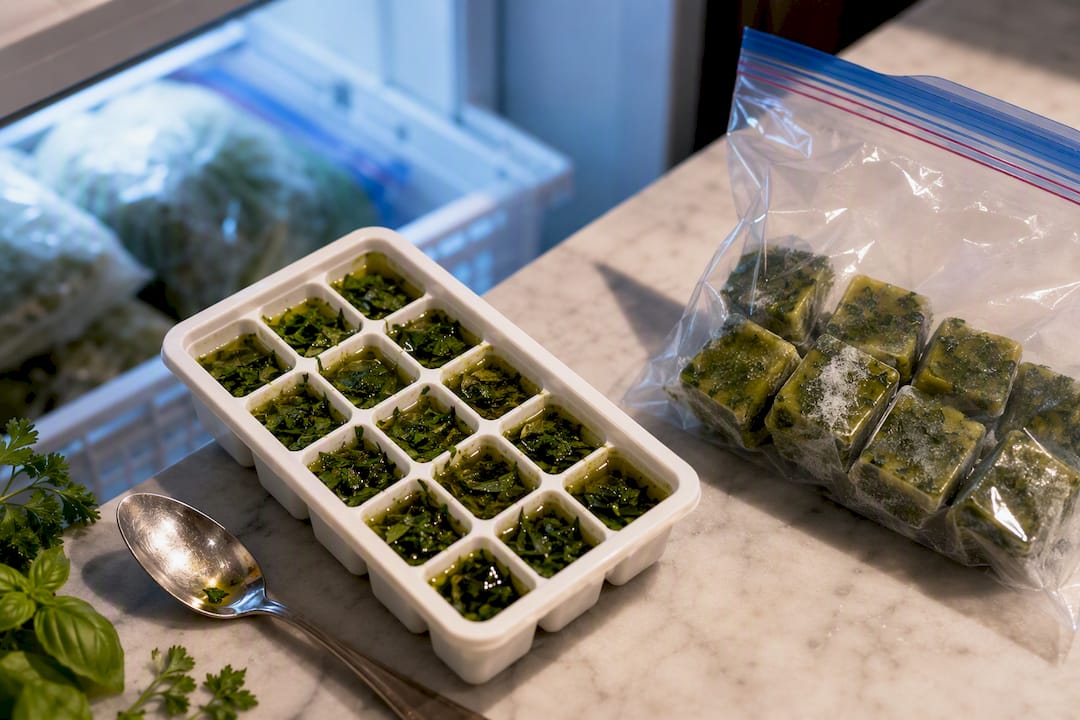
- Oil ice cubes: Chop herbs, pack them into an ice cube tray, and cover with a neutral oil like grapeseed or a light olive oil. Once frozen, pop the cubes into a labeled freezer bag. Each cube drops straight into a hot pan.
- Flat-layer freezer bags: Chop or leave leaves whole, spread them in a thin layer inside a freezer bag, press out the air, and freeze flat. This makes portioning easy since you can snap off what you need.
- Tray-packing: Spread whole sprigs or leaves on a baking sheet, freeze until solid, then transfer to a container. This keeps pieces from clumping together.
Freezing chopped herbs in a thin layer of oil rather than in ice-cube trays reduces freezer burn and makes portioning far easier, since the oil coats the leaf surface and slows the sublimation that causes freezer burn in the first place.
Label every bag with the herb name and the date. Most frozen herbs hold good flavor for 3 to 12 months depending on the method and how well the packaging keeps air out, with oil-packed cubes generally lasting toward the longer end. No thawing needed for cooking. Drop frozen herbs straight into a simmering pot, the same way you'd toss in frozen vegetables for a quick weeknight dish.
How Do You Dry Herbs for Long-Term Storage?
Drying makes sense when you're working with a large harvest, a bunch that's starting to fade, or hardy herbs you plan to use as pantry staples for seasoning day to day rather than as a fresh finishing touch.
- Air-dry by bundling stems together and hanging them upside down in a warm, dry spot out of direct sunlight for one to two weeks. This works best for low-moisture herbs like rosemary, thyme, and oregano.
- Dehydrate at 95°F to 115°F, which dries leaves evenly in a few hours without cooking off the volatile oils that carry flavor.
- Oven-dry on the lowest setting with the door slightly propped open, checking every 15 minutes since ovens run hotter than dehydrators and can scorch leaves fast.
- Microwave-dry in short 30-second bursts between paper towels for herbs you need in a hurry, watching closely since this method can go from dry to burnt in seconds.
Herbs are fully dry when leaves crumble easily between your fingers rather than bending. Store them whole or crumbled in an airtight jar, away from light and heat, and they'll hold good flavor for months.
How Long Do Stored Herbs Actually Stay Fresh?
Realistic expectations save you from tossing herbs too early or holding onto ones that have already gone flat on flavor.
- Tender herbs in a water jar: about 1 to 2 weeks with fresh water and regular re-trimming.
- Hardy herbs in damp towel storage: about 2 to 3 weeks in the crisper drawer.
- Frozen herbs: best used within 3 to 12 months, with texture loss from the start, so save them for cooked dishes.
- Dried herbs: stay flavorful for about 3 months at room temperature, longer if kept refrigerated or frozen, though potency fades gradually even in a sealed jar.
None of these are hard deadlines. A wilted parsley leaf on day 15 might still be fine chopped into a soup, while a slimy one on day 6 needs to go regardless of the calendar.
How Do You Fix Slimy, Moldy, or Freezer-Burned Herbs?
Sliminess and mold almost always trace back to trapped moisture, whether that's water left on leaves before storage or condensation building up inside a sealed bag.
- Slimy leaves: pull them out immediately. If only a few leaves in the bunch are affected, the rest is often still usable once rinsed and re-dried.
- Visible mold: discard the entire bunch. Mold spreads through moisture-heavy produce faster than it's visible to the eye.
- Freezer burn: those dry, grayish patches on frozen herbs come from air exposure. Press bags flat before freezing and use the oil-cube method for anything you'll store longer than a couple of months.
- Limp, wilted texture: rehydrate tender herbs by trimming the stems and standing them in fresh water for an hour before use. This often revives herbs that looked done for.
- Blackened basil: trim away the darkened edges and use the rest in a cooked sauce or pesto, where color matters less than flavor.
Pro Tip: When in doubt about mold versus surface dust, smell it. Sour or musty smells mean it's time to toss the bunch, no matter how it looks.
Why Do These Herb Storage Methods Actually Work?
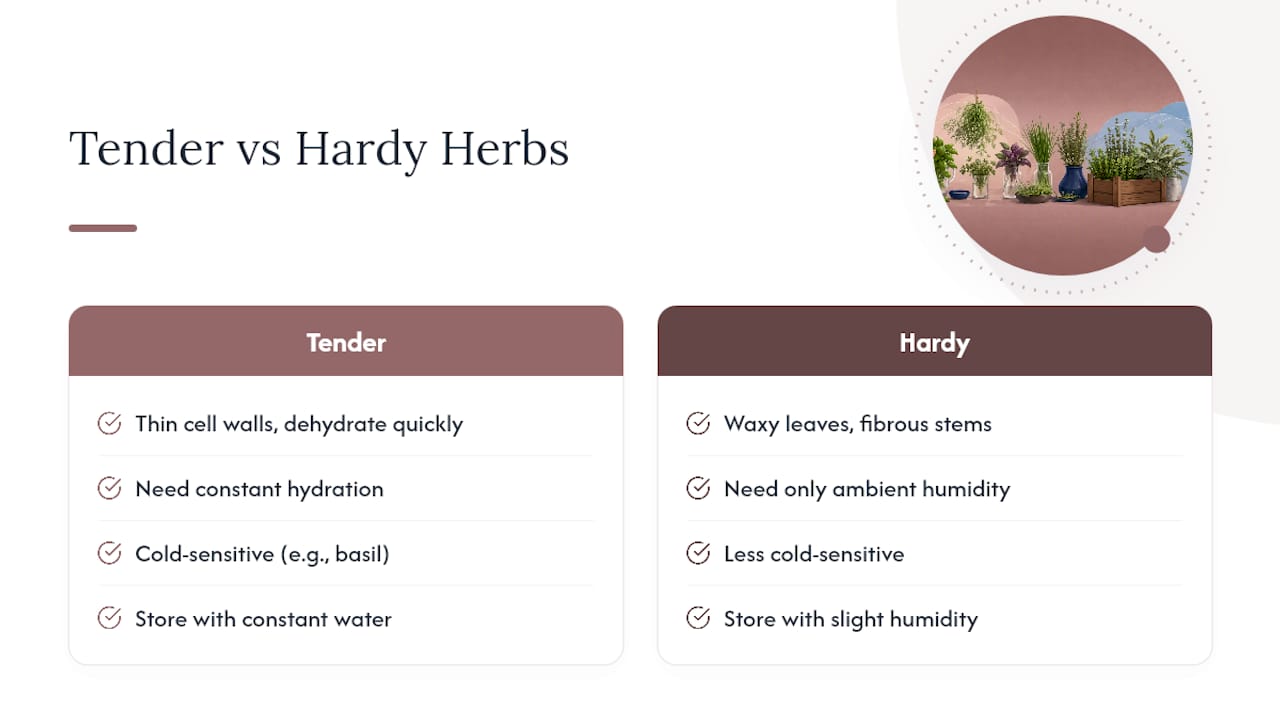
Every method above comes down to managing moisture and temperature at the cellular level, not just following tradition. Tender herbs need constant hydration because their high water content and thin cell walls mean they dehydrate within hours once cut off from a water source. Hardy herbs need only a little ambient humidity because their waxy leaf coating and fibrous stems already resist water loss.
Basil's cold sensitivity comes down to biology rather than preference. As a tropical plant, its cell membranes weren't built for refrigerator temperatures, and chilling injury damages those membranes within a day, causing the blackened, mushy patches you see on refrigerated basil.
Freezer burn follows its own physics. Sublimation pulls moisture out of frozen food and into the surrounding freezer air whenever ice crystals are exposed to it.
Removing air from packaging and coating herbs in oil or using a vacuum seal slows this moisture transfer significantly, which is why oil-packed herb cubes hold their flavor and color far longer than herbs frozen loose in a bag.
That single insight from the Missouri Botanical Garden explains why the oil method consistently outperforms basic freezing across nearly every herb variety.
A Weekly Herb Routine That Actually Sticks
Here's the habit I'd build if I were starting from scratch: inspect every bunch the moment you unpack your groceries, prep it immediately rather than tossing it in the crisper drawer as is, choose the storage method that matches its type, and label the jar or bag with the date. Rotate older herbs to the front so you use them before they turn.
One line to remember at every shopping trip: check, prep, store, label, rotate. Building small routines like this one is exactly what Adulting in the Kitchen is designed to teach, one habit at a time instead of one overwhelming overhaul.
— Bill
Want Help Turning Habits Like This Into a Whole Cooking Routine?
Knowing how to store herbs is one small piece of running a kitchen that doesn't waste food or money. AdultingintheKitchen builds that bigger picture for you, with a Starter Pack that sets up your kitchen right, weekly recipe drops with five new recipes, grocery checklists that take the guesswork out of shopping, and real chef support when a technique isn't clicking.

If you've read this far because you're tired of herbs going bad before you use them, that same instinct applies to half the stuff in your fridge. AdultingintheKitchen gives you the structure to fix that pattern across your whole kitchen, not just the herb drawer, with a supportive community and practical guidance built for beginners. Consider the Founding Member Starter Package for starting your cooking routines with supportive resources.
Sources
- National Center for Home Food Preservation — Preserving Herbs
- Penn State Extension — Freezing herbs
- University of Minnesota Extension — Preserving and preparing herbs
FAQ
What Is the Best Way to Store Fresh Herbs?
For tender herbs like parsley or cilantro, trim the stems and store them upright in a jar with an inch of water, loosely covered, in the fridge. For hardy herbs like rosemary or thyme, wrap them in a slightly damp paper towel inside a sealed bag or container.
How Do You Store Dried Herbs Long Term?
Keep dried herbs in an airtight jar in a cool, dark cupboard, where they'll hold good flavor for about three months at room temperature and longer if refrigerated or frozen.
Can You Freeze Fresh Herbs Instead of Drying Them?
Yes, freezing works well for herbs you'll use in cooked dishes, either chopped into oil-filled ice cubes or spread flat in freezer bags, and they stay usable for 3 to 12 months.
Why Does Basil Turn Black in the Refrigerator?
Basil is a tropical plant whose cell membranes suffer chilling injury at fridge temperatures, causing the dark, mushy spots you see within a day or two of refrigeration.
How Do You Know When Fresh Herbs Have Gone Bad?
Look for sliminess, visible mold, a sour or musty smell, or leaves that have turned dark and mushy rather than simply wilted. Wilted herbs can often be revived; slimy or moldy ones should be discarded.