The scaling factor is simple math: divide the servings you need by the servings the recipe already makes, then multiply every ingredient by that number. The one rule that trips people up is treating everything equally. Leaveners, salt, and strong spices don't scale 1 to 1 the way flour and liquid do, and weighing ingredients on a digital scale beats measuring by cup every time.
TL;DR:
- For accurate scaling, weight-based measurement is essential because volume varies and introduces errors, especially when multiplying ingredients like flour and sugar.
- Leaveners, salt, and spices should be scaled down to about 60-75% of their linear amount, then tested or tasted before increasing further, to avoid structural or flavor issues.
- Use pan area calculations to select the correct size, splitting batter into multiple pans if no one pan matches the scaled size, and adjust cooking time accordingly.
- Always convert ingredients to weight, apply the scaling factor carefully, and write down adjusted amounts beforehand to prevent mistakes during cooking.
- Testing substitutes for dietary restrictions should be done on small batches first, as absorption and behavior can change significantly when scaling larger, especially with gluten-free or vegan ingredients.
Table of Contents
- How Do You Scale a Recipe Step by Step?
- Why Weight Beats Volume for Accurate Conversions
- What Happens When You Scale Leaveners and Spices the Same as Flour?
- How Do You Pick the Right Pan for a Bigger or Smaller Batch?
- What Tools Do You Need to Scale Recipes Without Mistakes?
- Worked Examples: Scaling Up and Scaling Down
- How Adulting in the Kitchen Helps You Practice Scaling
- How Does Ingredient Temperature Affect Scaling Accuracy?
- How Do You Adjust for Moisture When Scaling a Recipe?
- How Do You Scale Recipes for Dietary Restrictions?
- Two Habits That Actually Make Scaling Reliable
- Get Guided Practice Scaling Recipes With Confidence
- Sources
How Do You Scale a Recipe Step by Step?
You want more (or fewer) servings than the recipe gives you. Here's the exact process, in order.
- Find your scaling factor. Divide desired servings by original servings. A recipe that makes 4 servings but needs to feed 10 gets a factor of 2.5 (10 divided by 4).
- Convert volume to weight wherever you can. If the recipe lists "2 cups flour," look up the gram equivalent before you start multiplying. Weight math compounds far fewer errors than volume math.
- Sort every ingredient into a category. Professional kitchens classify ingredients as linear, sub-linear, or non-linear before touching a calculator, and that one habit prevents most scaling disasters.
- Multiply the linear ingredients straight across. Flour, sugar, butter, milk, and most proteins scale directly with your factor. Two cups of flour times 2.5 is 5 cups (or, better, the gram equivalent).
- Apply special rules to sub-linear ingredients. Leaveners, salt, spices, and thickeners need dialed-back multipliers, which the next section covers in detail.
A quick way to sort ingredients before you multiply anything:
- Linear: flour, sugar, butter, oil, milk, most vegetables and proteins
- Sub-linear: baking powder, baking soda, salt, ground spices, gelatin, cornstarch
- Non-linear: cooking time, pan size, and sometimes leavening in very large batches
Most home recipes scale reliably between 0.5× and 3× their original size. Push past that range and you're better off running two batches than trusting the math on one giant one.
Why Weight Beats Volume for Accurate Conversions
A cup of flour can weigh anywhere from 120 to 150 grams depending on how it's scooped and packed, and that variance gets worse the more you multiply. Weight-based measurement removes that guesswork entirely, because a gram is a gram no matter who's holding the measuring cup.
Keep these common conversions handy when you're translating a cup-based recipe into grams:
- All-purpose flour: 1 cup ≈ 120 to 125 grams
- Granulated sugar: 1 cup ≈ 200 grams
- Butter: 1 cup ≈ 227 grams (one standard stick is 113 grams)
- Whole milk: 1 cup ≈ 240 grams
NIST's culinary measurement guidance backs this up: converting between volume and weight introduces error unless you're using consistent, calibrated tools. A kitchen scale that reads in 1 gram increments is the minimum sensitivity worth buying. Anything less precise defeats the purpose of weighing in the first place.
What Happens When You Scale Leaveners and Spices the Same as Flour?
You get a cake that domes and collapses, or a soup that tastes like you dumped in the whole spice rack. Baking powder, baking soda, salt, and ground spices don't behave in a straight line the way flour does, because chemical reactions and flavor perception don't scale proportionally with mass.
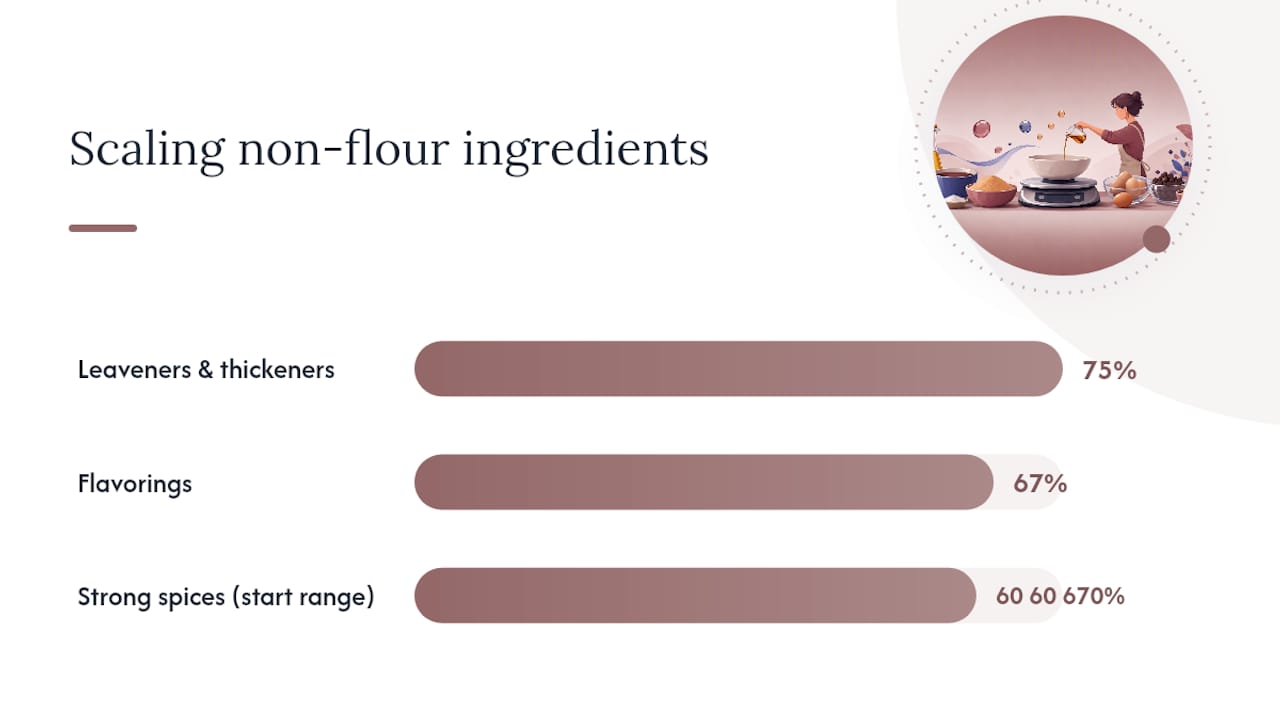
The starting rule from culinary schools: when scaling up, use roughly 75% of the linear scaled amount for leaveners and thickeners, then taste or test before committing to the full batch. Flavorings land around 67%, and strong spices like cayenne or cinnamon often need to start at just 60 to 70% of the calculated amount.
Salt follows the same logic. You can always add more salt. You can't easily remove it once it's stirred in.
Pro Tip: Before scaling a leavened baked good past 2×, run a small pilot batch first. It costs you one extra bake but saves you from wasting a full sheet pan of flat cookies or a sunken cake.
How Do You Pick the Right Pan for a Bigger or Smaller Batch?
Your ingredient math means nothing if the batter is twice as thick in the same pan. Depth changes everything about how heat moves through food, so matching pan area to your scaling factor matters as much as the ingredient list itself.
- Calculate area before you pick a pan: rectangular pans use length times width, round pans use pi times radius squared.
- Aim for a pan whose area is close to your original pan's area multiplied by your scaling factor, so the food depth stays roughly the same.
- If no single pan matches, split the batter across two pans instead of forcing it into one that's too small.
- Smaller batches often finish several minutes sooner than the original recipe states.
- Larger single pans may need more cooking time and sometimes benefit from a slightly lower oven temperature to cook evenly.
Cooking time tracks with thickness, not volume, which is why a thermometer or a doneness test beats a scaled-up timer every time. Set your timer as a guideline, then confirm with a probe or a toothpick.
What Tools Do You Need to Scale Recipes Without Mistakes?
Five items handle almost every scaling job: a digital scale with 1 gram sensitivity, a set of measuring spoons for small quantities, a printed or digital conversion chart, an instant read thermometer, and at least one pan smaller than your everyday size.
Run through this sequence every time you scale:
- Calculate your scaling factor and write it at the top of the recipe.
- Convert every ingredient to weight and multiply, applying sub-linear rules where needed.
- Write the adjusted amounts down before you start cooking, not while you're mid-recipe.
- Choose your pan (or pans) based on area math.
- Preheat the oven and reweigh any eggs or liquids that need fractional amounts.
The most common mistake isn't bad math. It's grabbing the original recipe card mid-cook out of habit and adding the unscaled amount instead of the adjusted one. Reading through the full recipe first before you touch an ingredient catches this before it happens.
Worked Examples: Scaling Up and Scaling Down
Numbers make this concrete. Here's the same math applied in both directions.
| Scenario | Original | Scaling factor | Adjusted result |
|---|---|---|---|
| Cake, scaled up | 4 servings, 2 cups flour, 1 tsp baking powder | 2.5× (10 ÷ 4) | 5 cups flour, baking powder at 75% of the scaled amount |
| Muffins, halved | 12 muffins, 2 large eggs | 0.5× | Whisk both eggs, weigh the mixture, use half by weight |
For the halved muffins, beating the eggs first and measuring half by weight solves the "you can't use one and a half eggs" problem cleanly. A recipe scaling app or calculator automates the multiplication and can flag which ingredients need the sub-linear treatment, but it still won't taste the dish for you.
How Adulting in the Kitchen Helps You Practice Scaling
Reading the math is one thing. Applying it under a hot stove is another. The Adulting in the Kitchen Starter Pack and weekly recipe drops give members real recipes to practice scaling on, from halving a weeknight dinner to doubling a dish for guests. Grocery checklists confirm you've bought the right adjusted quantities, and real chef support means you can ask "does this ratio look right?" before you commit a full batch to the oven.
How Does Ingredient Temperature Affect Scaling Accuracy?
Cold butter, room-temperature eggs, and lukewarm milk don't just affect texture. They affect how accurately your scaled measurements translate into the finished dish. Butter that's too cold resists creaming evenly into sugar, which matters more in a doubled batch where you're already asking the mixer to work harder to distribute fat through a larger volume.
Yeast is the clearest example. Scale up a bread recipe and use cold water where the original called for warm, and your rise time stretches unpredictably, throwing off every timing estimate you made based on the original recipe. Temperature-sensitive reactions like fermentation and gluten development don't scale on a simple ratio. They scale on time and heat, which your ingredient multiplier doesn't touch at all.
The practical fix is consistency, not precision. Pull eggs and dairy to room temperature before scaling a baking recipe, since a 2.5× batch of cold-butter batter behaves differently than a 2.5× batch made from properly softened butter, even though the gram weights are identical. When a recipe depends on a specific ingredient temperature for structure (whipped egg whites, creamed butter, proofed dough), hold that temperature constant across every batch size you make. The math handles quantity. Temperature handles behavior, and scaling ignores that distinction at your own risk.
How Do You Adjust for Moisture When Scaling a Recipe?
Doubling a soup or sauce rarely causes problems, since liquid volume and evaporation rate move together in fairly predictable ways. Doubling a baked good is where moisture gets tricky, because evaporation doesn't scale linearly with batch size the way your ingredient list does.
A larger cake batter in a proportionally larger pan still has a different surface-area-to-volume ratio than the original, which changes how much moisture escapes during baking. Bread dough scaled up in a humid kitchen behaves differently than the same dough scaled down on a dry winter day, independent of your ingredient math entirely.
The workaround culinary schools teach: hold back a small percentage of the liquid in a scaled-up batter or dough, then add it back gradually while mixing. If the texture looks right before you've used the full scaled amount, stop there. This matters most with recipes where hydration ratio drives the outcome, like bread, pancake batter, and pie dough. A pilot batch, mentioned earlier for leaveners, catches moisture problems just as reliably as it catches leavening problems, since both show up in the same test bake.
Sauces and braises are more forgiving. Reduction time changes with pan surface area, not with the multiplier you applied to the ingredient list, so a doubled braise in a wide Dutch oven might need less added simmer time than the math suggests, not more.
How Do You Scale Recipes for Dietary Restrictions?
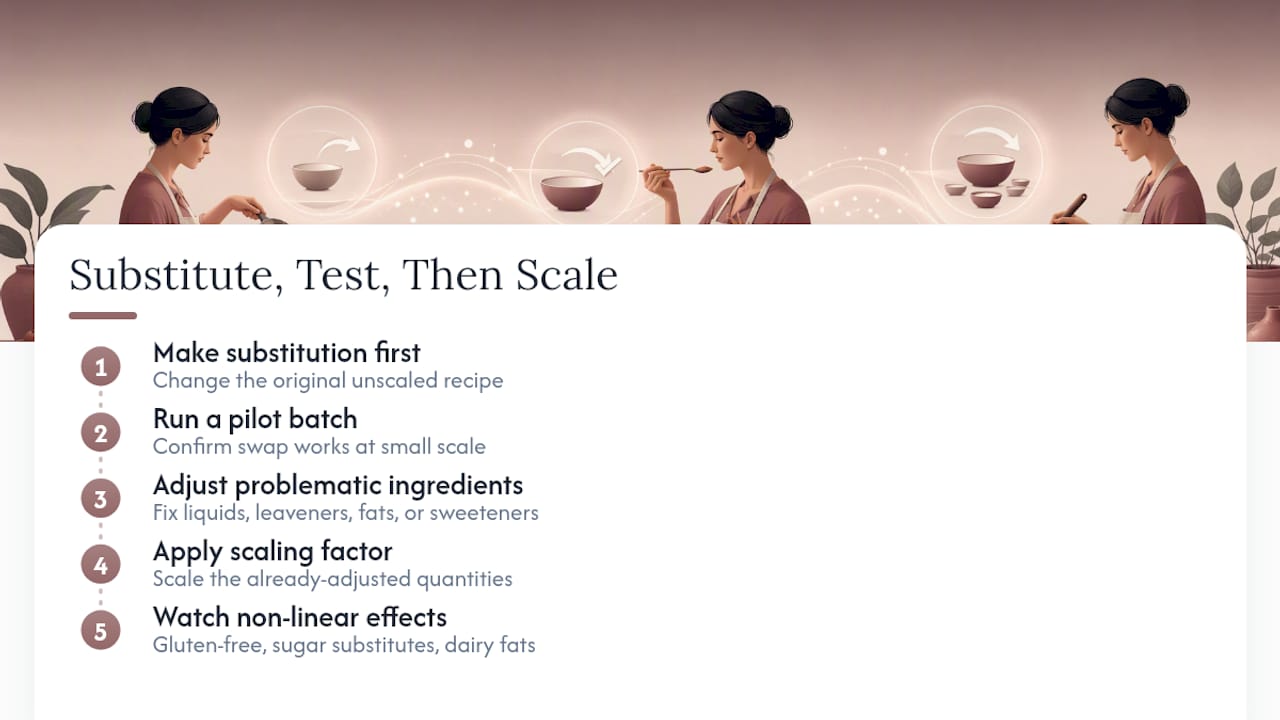
Substituting for a dietary restriction and scaling a recipe are two separate problems, and solving them in the wrong order compounds errors. Make your substitution first on the original, unscaled recipe. Confirm the swap works at the small scale before you multiply anything.
Gluten-free flour blends absorb liquid differently than wheat flour, and that difference gets more pronounced as batch size grows. A gluten-free bread recipe that needs a splash more liquid at the original size may need proportionally more than a straight multiplier suggests once you scale it up, because the starch-to-liquid ratio in most blends isn't linear the way wheat flour's is.
Sugar substitutes carry their own scaling quirks. Some, like monk fruit blends, are far more concentrated than sugar by volume, so a recipe converted for a sugar substitute and then scaled needs the substitute conversion applied first, then the scaling factor applied to the already-converted amount, not the original sugar quantity.
Dairy-free fat substitutes (coconut oil, vegan butter) behave differently at room temperature than dairy butter, which circles back to the temperature-sensitivity issue covered earlier. That interaction gets magnified in a larger batch where creaming or emulsifying has to work harder.
The safest approach: treat every dietary substitution as its own small pilot batch before scaling, the same discipline recommended for leaveners and moisture. Confirm the swap works, then apply your scaling factor to the adjusted recipe rather than trying to solve the substitution and the scaling math simultaneously.
Two Habits That Actually Make Scaling Reliable
Most scaling failures trace back to skipped habits, not bad math. Writing your adjusted amounts down before you cook, rather than trusting mental math mid-recipe, prevents the majority of scaling mistakes I've seen discussed by culinary instructors. Practice on simple recipes first, and let the kitchen scale become second nature before you scale something with six special ingredients.
— Bill
Get Guided Practice Scaling Recipes With Confidence
AdultingintheKitchen gets you scaling recipes correctly faster than trial and error at the stove ever will, because you're not guessing alone. You've got the formula and the pilot-batch discipline now. What you need next is real recipes to practice on and someone to check your work before you commit a full batch.

The Adulting in the Kitchen Starter Pack walks new cooks through kitchen setup and measurement basics from day one, so scaling math sits on top of a solid foundation instead of shaky guesswork. Weekly recipe drops give you five new recipes to practice scaling up or down, grocery store checklists confirm you're buying the right adjusted quantities, and real chef support means you can ask "does this ratio look right?" before the batch hits the oven. If you're planning a bigger gathering and need to scale beyond your usual recipe count, smart hosting habits pair well with the scaling skills you just learned here.
Ready to stop second-guessing your math? Join Adulting in the Kitchen and grab the starter worksheet built for exactly this kind of practice.
Sources
- Cooking for a Crowd: Techniques for Scaling Recipes — Auguste Escoffier School of Culinary Arts
- How to scale recipes without mistakes — Cooklang
- Cooking basics — Reducing a recipe (Kansas State SNAP-Ed)
- Culinary measurement tips — NIST