The fastest path to a trustworthy cooking answer is a community forum for quick troubleshooting, an editorial "ask a chef" hotline for curated help, a paid expert-answer service for safety-critical questions, or a chef-backed membership for ongoing support. Whichever route you pick, always hand over five things: the ingredient, the exact quantities, your temperature and time, the equipment you used, and the result you're after. Skip the checklist and you'll get a guess instead of an answer.
TL;DR:
- Quick troubleshooting with community forums provides rapid answers but lacks accountability, so verify key details like temperature and timing with trusted sources.
- Curated hotlines or searchable expert Q&A are better for trustworthy advice you can revisit, especially when safety or technical accuracy matters.
- For complex or recurring issues, a chef membership offers ongoing support, structured lessons, and habit-building tools that surpass single-question fixes.
- Precise questions should include recipe links, ingredient amounts, cooking temperatures, times, equipment details, and photos, especially cross-sections, for useful responses.
- Safety-critical food questions must follow food safety guidelines, such as keeping perishables out of the danger zone and measuring internal temperatures for doneness.
Table of Contents
- Where to Ask Cooking Questions: Forums, Hotlines, and Chef Support
- How to Ask So You Get a Useful Answer
- Common Cooking Questions and Fast Answers You Can Use Now
- Food-Safety Quick Rules Every Asker Should Know
- Meal-Prep and Storage Basics That Come Up Often
- Why Expert-Backed Answers Beat a Random Guess
- Ask, Test, Repeat: A Perspective on Getting Better Answers
- Ready for Answers That Stick, Not Just One-Off Fixes?
- Sources
- FAQ
Where to Ask Cooking Questions: Forums, Hotlines, and Chef Support
Every place to ask a cooking question trades speed for depth, or depth for speed. Knowing which trade-off you're making up front saves you a ruined dinner.
Community forums are the fastest option, and they're genuinely good at troubleshooting and kitchen hacks. Post a photo of a broken sauce at 6:45 p.m. and you'll likely have three replies before your pan cools. The catch: answers come from strangers with no accountability, so cross-check anything involving temperature or timing against a source you trust before you act on it.
Editorial hotlines and curated "ask a chef" pages, in the style Food52 popularized, move slower but the answers are edited, fact-checked, and searchable later. If you're not in a rush, this is a better bet than a forum thread that might vanish in an algorithm reshuffle.
Paid expert-answer services exist for a reason: some questions are too specific, or too safety-critical, for crowdsourced guesses. A model like AskedWell, which accepts a specific question and returns a short, source-cited answer, works well when you need a citation attached to the reply, not just an opinion.
Chef-backed memberships fill a different gap entirely. If you're asking the same category of question every week, roughly, is this done, can I sub this, why did this stick, a one-off answer doesn't fix the underlying problem. That's where a chef-backed membership fits, pairing structured lessons with real chef support instead of a single isolated reply.
A rough guide to fit:
- Fast troubleshooting tonight: community forum
- A question worth trusting and revisiting later: editorial hotline or Q&A archive
- Safety-critical or highly technical: paid expert service
- Recurring questions and skill-building: chef membership
How to Ask So You Get a Useful Answer
Vague questions get vague answers. "Why is my chicken dry?" gives an answerer nothing to work with. "Why is my chicken dry?" plus your oven temp, cook time, and cut of meat gives them everything.
Include these details every time; if you have questions about your equipment, check out this handmade chef set to better understand your tools.
- The recipe or a link to it
- Exact ingredient amounts, especially for substitutions
- Oven or stovetop temperature you used
- Total cooking time and how you measured doneness
- The equipment involved (cast iron, nonstick, air fryer, etc.)
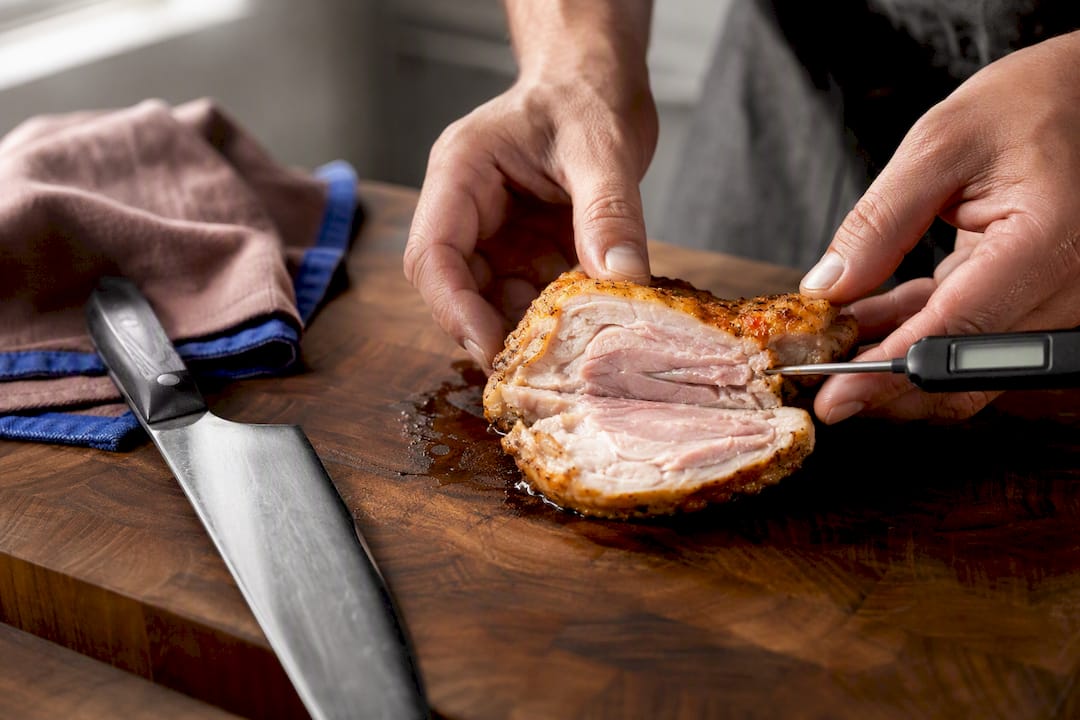
- A photo, ideally a cross-section, not just the surface
A two-line template works for almost anything:
Troubleshooting example: "I seared salmon skin-side down in a stainless pan at medium-high for 6 minutes and it stuck badly. Pan was preheated 2 minutes. What went wrong?" Substitution example: "Recipe calls for 1 cup buttermilk. I only have whole milk and lemon juice. What ratio keeps the texture right?"
Pro Tip: Photograph the cross-section of whatever went wrong, along with your thermometer reading in place. A cut-open chicken thigh tells an answerer more in one image than three paragraphs of description.
Common Cooking Questions and Fast Answers You Can Use Now
Most cooking questions fall into five recurring buckets. Knowing the fast answer to each saves you a round trip to any forum.
- Timing and doneness: Don't trust the clock. Measure internal temperature in the thickest part of the meat with a probe thermometer, since color is unreliable and cook times vary by pan, stove, and starting temperature, according to USDA/FSIS. Pull poultry right at the safe temperature and let carryover cooking finish the job during rest.
- Substitutions: Ratio rules help, but they have limits. One tablespoon ground flaxseed plus three tablespoons water replaces one egg in baking, but it won't work in a soufflé that depends on egg structure for lift.
- Technique fixes: Soggy vegetables usually mean overcrowding the pan; sauce separation usually means the heat was too high when fat and liquid were combined.
- Measurement: When precision actually matters, like baking, weigh ingredients instead of using cup measures, which vary by how tightly you pack them.
For equipment-specific questions, a basic tools guide helps you name what you're using so an answerer can diagnose the actual problem.
Food-Safety Quick Rules Every Asker Should Know
Any answer involving meat, dairy, or leftovers has to match official food-safety guidance, or it isn't an answer, it's a guess with consequences.
The 2-hour rule: Cooked or raw perishable food shouldn't sit at room temperature longer than 2 hours, and that window drops to 1 hour if the room is warm. Reheating food does not reset this clock, according to UF/IFAS Extension.
Internal temperature is the only reliable doneness test:
- Chicken: 165°F minimum for safety
- Chicken thighs: often best at 175 to 195°F, where connective tissue breaks down for tenderness, per FSIS guidance
- Ground meats: measure in the center, not the surface
- Fridge: 40°F or below; freezer: 0°F or below
Label every stored item with the date it was made and use FIFO, first in, first out, so older food gets used before newer batches, a practice USDA's refrigeration guidance recommends to cut spoilage risk. Our own food safety basics guide walks through storage windows in more detail if you want a deeper reference.
Meal-Prep and Storage Basics That Come Up Often
Meal prep isn't one method, it's a spectrum, and Nutrition frames it as running from simple ingredient chopping all the way to full batch-cooking. Picking one method you'll actually repeat beats an ambitious plan you abandon by week two.
- Chopping only: fastest, best for busy weeknights
- Portioned full meals: best for grab-and-go lunches
- Ready-to-cook ingredients: best if you still want to cook fresh most nights
Storage timelines vary by ingredient, so label containers and follow FIFO. If you're cooking solo, our meal planning for one guide walks through a waste-free weekly system worth adapting.
Pro Tip: Cap yourself at one oven dish and two stovetop items running at once. A Reddit meal-prep discussion backs this up: more than that and you're just creating bottlenecks and burnt edges.
Why Expert-Backed Answers Beat a Random Guess
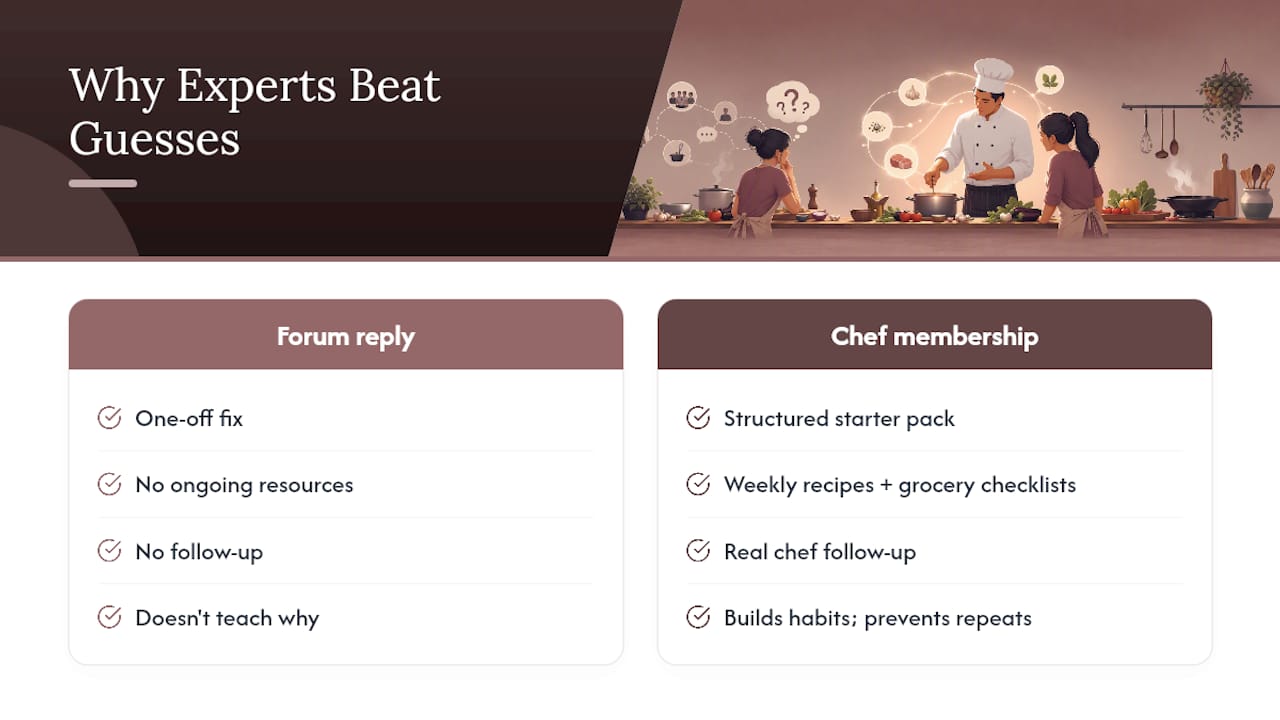
A single forum reply can't teach you why something went wrong, only that it did. A chef-backed membership with a starter pack, weekly recipe drops, grocery checklists, and real chef support builds the habits that stop the same question from resurfacing every week. If you're a habit builder who wants follow-up, not just a fix, that structure beats a one-off answer every time.
Ask, Test, Repeat: A Perspective on Getting Better Answers
Most home cooks ask one question and stop. Better cooks turn the answer into a small experiment, rest one chicken thigh five minutes, another ten, and compare. That's how a fact becomes a skill. Just run the experiment around the safety rules already covered here, not against them.
— Bill
Ready for Answers That Stick, Not Just One-Off Fixes?
Random forum replies fix tonight's dinner. They don't build the judgment to avoid the same mistake next week. A chef-backed membership closes that gap with a structure built for repeat learning: a starter pack to set up your kitchen, weekly new recipes, grocery checklists so shopping stops being a guessing game, and real chef support when a recipe doesn't behave the way you expected.
This fits best if you're tired of asking the same question in three different places and getting three different answers. Instead of hunting for advice every time something goes wrong, you get a system that teaches you why, plus someone to ask when it doesn't. Check out Adulting in the Kitchen's membership details to see what a typical week looks like, or browse the shop to see what's included in the Starter Pack before you commit.
FAQ
What Are Good Questions to Ask About Cooking?
The most useful questions name the exact ingredient, quantity, temperature, time, and equipment used, plus the result you got, since specifics get specific answers while "why did this fail" gets a guess.
What Is the 2-2-2 Rule in Cooking?
There isn't a standard, widely recognized "2-2-2 rule" in professional food-safety guidance; the rule cooks should actually know is the 2-hour rule, which limits perishable food to 2 hours at room temperature, or 1 hour if the room is warm.
What Are Fun Questions to Ask About Food?
Try questions that dig into technique history or flavor science, like why searing browns meat, what makes sourdough sour, or why resting meat matters, since these spark curiosity while still teaching a real skill.
What Are the 5 P's of Cooking?
There's no single, universally recognized "5 P's" framework in professional culinary standards, so treat any version you see online as informal shorthand rather than an established rule.
Where Should I Ask a Cooking Question if I Want an Expert Chef's Help?
For ongoing, expert-backed help rather than a one-off reply, a chef-backed membership pairs real chef support with weekly recipes, so you get answers plus the structure to stop repeating the same mistakes.