The whole system boils down to three moves: rinse your pan while it's still warm, dry it completely with a towel and a quick blast of stovetop heat, then wipe on a thin film of neutral oil. Do those three things after every single cook, and your cast iron will outlast the drive-thru habit you're trying to quit. Skip them, even once or twice, and you'll be fighting rust or sticky patches instead of cooking dinner.
TL;DR:
- Proper cast iron maintenance requires warming the pan for rinsing and drying it fully on the stovetop to prevent rust, especially after cooking residues harden.
- Regular cooking with fats accelerates seasoning development, while oven seasoning is best for patchy or new pans, typically involving a few coats at high temperatures.
- Avoid soaking, rapid temperature changes, and storing wet pans to preserve seasoning, while using low-above high-smoke-point oils like canola or vegetable for upkeep.
- Use a chainmail scrubber or stiff brush for routine cleaning, avoid dishwasher and abrasive powders, and reseason only when food begins sticking or dull patches appear.
- Enamel cast iron needs gentle soap and soft pads, avoids seasoning, and is sensitive to thermal shocks, while bare cast iron demands oil, warmth, and gentle abrasion for best care.
Table of Contents
- What Is the Real Routine for Cast Iron Care?
- How Does Seasoning Actually Work?
- How Do I Fix Stuck Food, Rust, or Rancid Smells?
- Which Tools and Oils Actually Belong in Your Kitchen?
- Where and How Should You Store Cast Iron?
- Is Cast Iron Care Different for Enameled Pans?
- What Mistakes Wreck Cast Iron Seasoning Fastest?
- Cast Iron Care for Beginners: A 60-Second Daily Routine
- Ready to Build Real Kitchen Confidence Beyond the Pan?
- Sources
- FAQ
What Is the Real Routine for Cast Iron Care?
Your cast iron care routine takes less time than waiting for water to boil. Here's the exact sequence, start to finish.
- Rinse while the pan is still warm. Hot water loosens the fond (those browned bits stuck to the surface) far faster than cold water on a cooled pan. Do this right after you plate your food, not after the dishes pile up.
- Scrub for 15 to 30 seconds with a chainmail scrubber or a stiff brush. Most residue lets go fast: fond from a seared steak clears in about 5 seconds, cornbread crumbs in around 10, and fried egg residue can take closer to 30. If food is really stuck, a drop of mild dish soap is fine here, contrary to what you may have heard.
- Towel dry, then finish on the stove. Set the pan on a burner for 30 to 60 seconds until any hissing stops. This step matters more than almost anything else you'll do, because moisture, not soap, is what actually causes rust.
- Wipe on a small amount of neutral oil with a paper towel, then buff off the excess so the surface looks matte, not greasy.
That's the whole routine, and research on cast iron maintenance backs up exactly this order: rinse warm, scrub briefly, dry fully on the stovetop, then oil.
Pro Tip: Keep a small dish of oil and a folded paper towel right next to your stove. If the tools are already there, you'll actually do the oiling step instead of skipping it because you're tired.
Some nights you'll get away with a 10 second rinse and nothing else. That's fine for a quick sear where nothing browned onto the metal. But once you see any stuck bits, don't just rinse and walk away. Scrub them now, while the pan is warm and cooperative, instead of tomorrow when they've hardened.
How Does Seasoning Actually Work?
Seasoning is layers of oil that have been baked onto the iron until they turn into a hard, slick, plastic-like coating. Chemists call this polymerization. In plain terms, heat transforms liquid fat into a bonded surface that fills the pan's microscopic pores and keeps food from sticking to bare metal.
A brand-new preseasoned skillet is usable right out of the box, but the coating is thin. It builds real depth the more you cook with it, especially with fatty foods like bacon or a butter-basted steak. That's not a workaround, it's the intended process. Professional kitchens and manufacturers generally agree that regular cooking with fat builds a durable seasoning layer faster and more reliably than oven seasoning alone.
Sometimes you need to speed things up or fix a rough patch, and that calls for oven seasoning:
- Rub a very thin, almost invisible coat of oil over the entire pan, inside and out.
- Place it upside down in a 450 to 500 degree oven for 30 to 60 minutes.
- Repeat one to three times if the surface still looks patchy.
This oven method is the standard fix whether you're breaking in a new pan or bringing an old one back. You'll know it's time to reseason when food starts sticking that never used to, or when you notice dull gray patches where the black coating has worn away.
How Do I Fix Stuck Food, Rust, or Rancid Smells?
Most cast iron panic comes down to four scenarios, and each one has a specific fix. Don't reach for oven cleaner or a wire brush for any of them.
- Stuck-on or burnt food: Add 1 to 2 tablespoons of kosher salt and about half an inch of water, then simmer for 3 to 5 minutes. This loosens carbonized residue without harsh chemicals, and a quick scrub afterward finishes the job.
- Heavy, sticky buildup: Make a paste from baking soda and a little water, let it sit on the problem spot for a few minutes, then scrub. This handles gunk the salt method can't quite budge.
- Small rust spots: Scrub the rust down to bare gray metal with a chainmail scrubber or fine steel wool, dry the pan completely, then do one round of oven seasoning to reseal that spot.
- Rancid oil smell: A hot, soapy scrub followed by full stovetop drying and a fresh oven seasoning round clears out old, rancid oil and rebuilds the surface.
If rust has spread across the whole cooking surface, or the buildup is thick and cracked, strip the pan completely and start seasoning from scratch.
Pro Tip: Never use oven cleaner, Comet, or Bar Keepers Friend for these fixes. They strip seasoning far past bare metal and force you into a full reseason you didn't need.
Which Tools and Oils Actually Belong in Your Kitchen?
You need almost nothing to keep cast iron in good shape, and that's part of the appeal.
- A chainmail scrubber or a stiff nylon brush handles daily cleaning without scratching seasoning.
- Skip wire brushes for routine cleaning; save fine steel wool for rust removal only.
- Keep cast iron out of the dishwasher entirely. The prolonged soak and harsh detergent strip seasoning faster than almost anything else you could do.
- For oil, stick with neutral, high-smoke-point options like canola, vegetable, or grapeseed oil. Manufacturers and test kitchens consistently recommend these for both seasoning and everyday maintenance. Flaxseed oil forms a hard coating too, but it can flake with use, so it's optional rather than essential.
For daily maintenance, a quarter teaspoon buffed thin is plenty. For oven seasoning, use just enough to coat the surface without leaving any pooling. A pan that comes out of the oven shiny and wet with oil has too much on it. Our cooking oil guide breaks down smoke points if you want to understand why some oils work better here than others.
Where and How Should You Store Cast Iron?
Store your pan somewhere dry with a little airflow around it. Don't seal it inside a plastic bag or a tightly closed drawer where moisture can collect, since trapped humidity is exactly what turns a well-oiled pan into a rusty one.
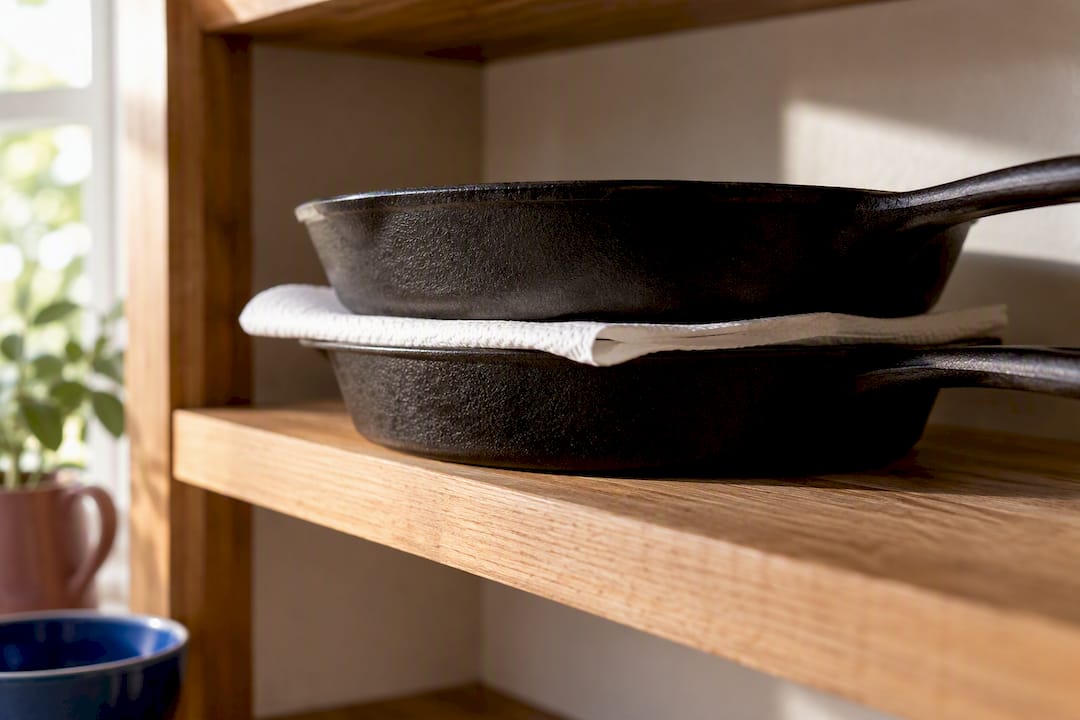
If you stack pans, slide a folded paper towel between them to catch stray moisture and prevent scratching. Using your pan often actually helps its seasoning; cooking bacon or searing something in butter every week or two does more for the coating than any oven seasoning session. Give the pan a quick wipe with a paper towel before cooking if it's been sitting a while, and save the full clean, dry, oil routine for after you cook.
Is Cast Iron Care Different for Enameled Pans?
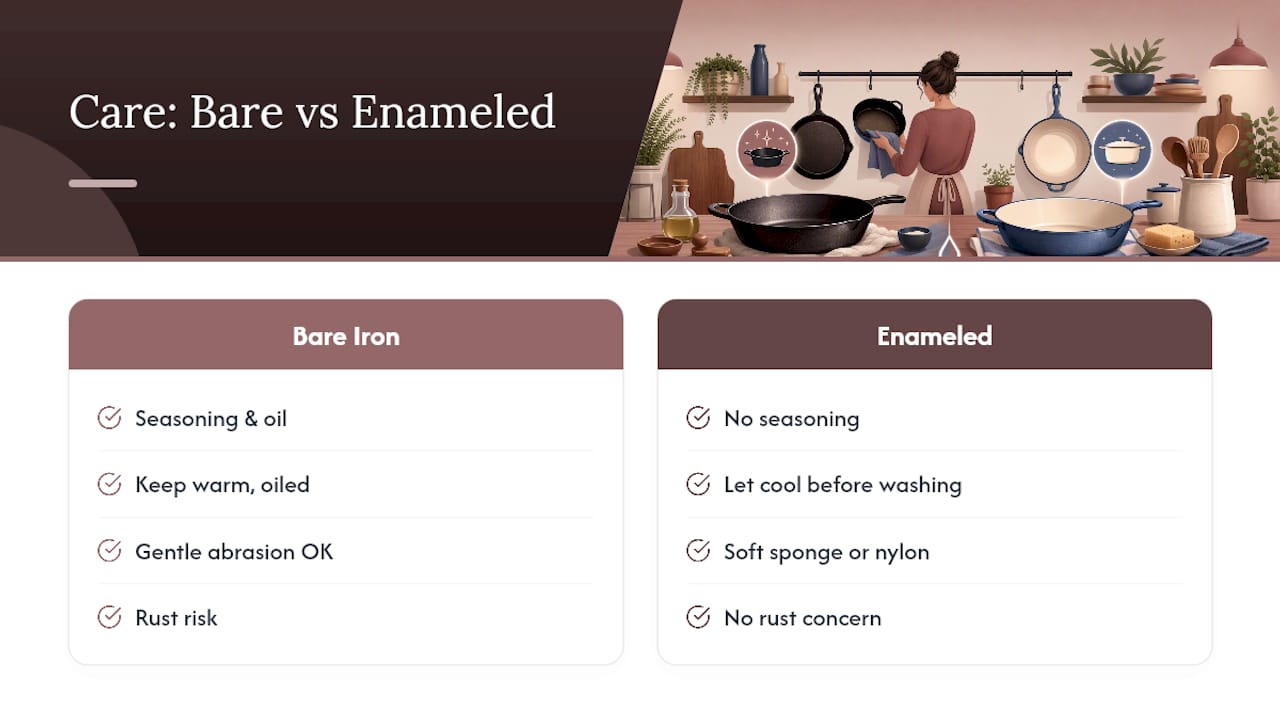
Enameled cast iron flips several of these rules. The glassy coating on brands like Le Creuset or Staub isn't bare iron, so there's no seasoning to protect and no oil layer to maintain. You can use regular dish soap freely, and a soft sponge is all you need for daily cleaning.
Skip the chainmail scrubber and steel wool on enameled pieces. Both will scratch the glaze, and once it's scratched, food and stains work their way into those grooves permanently. A nylon scrub pad or a baking soda paste handles stuck food on enamel just as well without the risk.
Rust isn't a concern with enameled cast iron since the coating itself keeps moisture off the metal underneath. That said, enamel is more sensitive to thermal shock than bare cast iron. Pouring cold water into a hot enameled pot can crack the glaze outright, so let it cool most of the way before it hits the sink.
Bare cast iron and enameled cast iron end up needing opposite instincts from a beginner cook. Bare iron wants oil, warmth, and gentle abrasion. Enamel wants soap, softness, and temperature patience. Mixing up which pan gets which treatment is one of the most common ways people damage cookware they were trying to take care of.
What Mistakes Wreck Cast Iron Seasoning Fastest?
A handful of habits do more damage than anything else on this list, and most of them feel harmless in the moment.
Letting a pan soak in the sink is probably the single biggest seasoning killer. Water sitting against warm iron for even 20 minutes starts breaking down that polymerized layer, and overnight soaks can strip a pan down toward bare metal. Wash it right after cooking instead of leaving it for later.
Rapid temperature swings crack seasoning and can even warp thinner cast iron. Running cold tap water over a screaming hot pan, or setting a hot pan straight onto a cold wet counter, shocks the metal. Let it cool a minute first, or use warm water rather than cold for that initial rinse.
Storing it wet is a close cousin of soaking. Even a pan that looks dry can hold enough surface moisture to start rust if it goes straight into a cabinet. That's why the stovetop heat-dry step exists.
Cooking acidic food for long stretches in a barely-seasoned new pan can also eat into a thin coating, though a well-seasoned pan handles a splash of wine or tomato sauce just fine.
None of these mistakes are permanent. Every one of them is fixable with the salt scrub, the baking soda paste, or a round of oven seasoning covered earlier.
Cast Iron Care for Beginners: A 60-Second Daily Routine
Here's the opinion I'll stand behind after digging through how manufacturers, chefs, and extension services all describe this process: the "never use soap" rule has done more harm than good. It scares beginners into skipping a real clean when their pan genuinely needs one, and that hesitation leads to worse habits, like scraping with metal tools or letting food dry on overnight because "soap is off limits." A drop of mild dish soap paired with real drying is safer than a soap-phobic pan that sits dirty.
The overrated fix, by contrast, is obsessive reseasoning. New cooks treat the oven seasoning method like a monthly chore, when it's really an occasional repair tool. A pan that gets used weekly and dried properly barely needs it.
If you take one thing from this article, make it the drying step. Rust problems are drying problems in disguise. Master that, and stuck food, rust, and rancid smells become rare instead of routine.
— Bill
Ready to Build Real Kitchen Confidence Beyond the Pan?
Cast iron care is one skill, but building a kitchen you actually trust takes more than mastering one pan. A digital cooking membership gives beginners the structure that recipe blogs and random videos can't: a starter pack that tells you exactly what to buy, weekly recipe drops with new dishes to practice technique, grocery checklists to help at the store, and real chef support when something goes sideways.

That kind of guided repetition is exactly what turns the 60-second cast iron routine, and every other kitchen habit, into muscle memory instead of something you have to look up every time. If you're tired of drive-thru dinners and want a clear path from "I own a pan" to "I actually know how to cook," check out the Adulting in the Kitchen membership and start your first week of recipe drops.
Sources
For deeper troubleshooting or brand-specific instructions, lean on manufacturer care pages alongside trusted guides like MSU Extension, Serious Eats, and The Cast Iron Craft.
- Caring for cast iron pans is as easy as 1 - 2 - 3 - MSU Extension
- How to Clean a Cast Iron Skillet (Yes, Soap Is Fine) | The Cast Iron Craft
- How to season cast-iron pans, skillets, cookware | Serious Eats
FAQ
Do You Need to Oil Cast Iron After Every Use?
Yes, a thin wipe of neutral oil after each cleaning keeps the seasoning intact and moisture-resistant. Use about a quarter teaspoon, buffed until the surface looks matte rather than greasy.
How Should You Take Care of a Cast Iron Skillet Day to Day?
Rinse it while it's still warm, scrub briefly with a chainmail scrubber, dry it completely with a towel and a short stint on the stove, then wipe on a light coat of oil. This four-step sequence handles the vast majority of everyday cleaning and prevents rust.
What Should You Never Clean Cast Iron With?
Avoid the dishwasher, oven cleaner, abrasive powders like Comet or Bar Keepers Friend, and wire brushes for routine cleaning. These strip seasoning far more aggressively than necessary and invite rust.
Are Cast Iron Pans Good for People With Anemia?
Cooking in cast iron can add small amounts of iron to food, particularly acidic dishes cooked for longer periods, but it isn't a reliable substitute for medical treatment or iron supplementation. Anyone managing anemia should talk to a doctor about diet and treatment rather than relying on cookware alone.
Where Can Beginners Practice Cast Iron Skills With Support?
AdultingintheKitchen's membership pairs weekly recipe drops with chef support, so you can practice searing, frying, and building seasoning on real dishes instead of guessing alone. Current pricing and details are available on the membership page.